Pearson+ LogoPearson+ Logo
Ch.9 Solutions
McMurry - Fundamentals of GOB 8th Edition
McMurry8th EditionFundamentals of GOBISBN: 9780134015187Not the one you use?Change textbook
Chapter 9, Problem 72a

Calculate the mass needed for each of the following ion equivalents:
a. 0.25 Eq Ca2+

Verified step by step guidance
1
Understand the concept of equivalents: An equivalent (Eq) is a measure of reactive capacity. For ions, it is calculated based on the charge of the ion. For calcium ion (Ca²⁺), 1 mole of Ca²⁺ provides 2 equivalents because its charge is +2.
Determine the molar mass of calcium (Ca): Look up the atomic mass of calcium on the periodic table. The molar mass of calcium is approximately 40.08 g/mol.
Relate equivalents to moles: Use the relationship between equivalents and moles for Ca²⁺. Since 1 mole of Ca²⁺ equals 2 Eq, the number of moles corresponding to 0.25 Eq can be calculated as: \( \text{moles of Ca}^{2+} = \frac{\text{Eq of Ca}^{2+}}{2} \).
Calculate the mass of calcium: Use the formula \( \text{mass} = \text{moles} \times \text{molar mass} \). Substitute the moles of Ca²⁺ (from the previous step) and the molar mass of calcium to find the mass required.
Combine all the steps: First, calculate the moles of Ca²⁺ from the equivalents, then multiply by the molar mass to find the mass of calcium needed for 0.25 Eq.

Verified video answer for a similar problem:

This video solution was recommended by our tutors as helpful for the problem above.
Video duration:
1m
Was this helpful?

Key Concepts

Here are the essential concepts you must grasp in order to answer the question correctly.

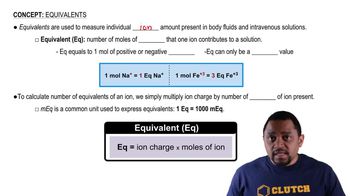
Equivalent Weight

Equivalent weight is the mass of a substance that will combine with or displace one mole of hydrogen atoms or one mole of electrons in a chemical reaction. For ions, it is calculated by dividing the molar mass of the ion by its charge. Understanding equivalent weight is crucial for determining how much of a substance is needed to achieve a specific ionic concentration.
Recommended video:
Guided course
01:43
Equivalents Concept 1

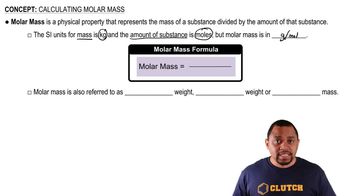
Molar Mass

Molar mass is the mass of one mole of a substance, typically expressed in grams per mole (g/mol). It is a fundamental property used to convert between the mass of a substance and the number of moles. For calcium ions (Ca²⁺), the molar mass is approximately 40.08 g/mol, which is essential for calculating the mass required for a given number of equivalents.
Recommended video:
Guided course
01:10
Calculating Molar Mass

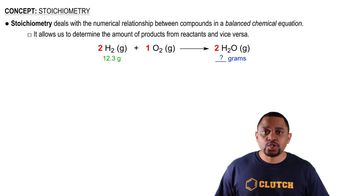
Stoichiometry

Stoichiometry is the branch of chemistry that deals with the quantitative relationships between reactants and products in a chemical reaction. It allows for the calculation of the amounts of substances involved based on balanced chemical equations. In this context, stoichiometry is used to relate the number of equivalents of calcium ions to the mass needed for a specific reaction or solution.
Recommended video:
Guided course
01:16
Stoichiometry