Pearson+ LogoPearson+ Logo
Ch.9 Solutions
McMurry - Fundamentals of GOB 8th Edition
McMurry8th EditionFundamentals of GOBISBN: 9780134015187Not the one you use?Change textbook
Chapter 9, Problem 69

What does it mean when we say that the concentration of Ca2+ in blood is 3.0 mEq/L?

Verified step by step guidance
1
Understand the term 'mEq/L': It stands for milliequivalents per liter, which is a unit used to express the concentration of ions in a solution. It accounts for both the amount of the ion (in moles) and its charge (valence).
Recognize the ion in question: Ca²⁺ is calcium ion, which has a charge of +2. This means each mole of calcium ions contributes 2 equivalents of charge.
Relate milliequivalents to equivalents: 1 milliequivalent (mEq) is equal to 1/1000 of an equivalent. Therefore, 3.0 mEq/L means 3.0 milliequivalents of Ca²⁺ are present in 1 liter of blood.
Determine the molar concentration: To convert from mEq/L to mol/L, divide the mEq/L value by the charge of the ion. For Ca²⁺, divide 3.0 mEq/L by 2 (since the charge is +2).
Interpret the result: The concentration in moles per liter (mol/L) represents the actual number of calcium ions in the blood, while the mEq/L value reflects the ionic charge contribution to the solution.

Verified video answer for a similar problem:

This video solution was recommended by our tutors as helpful for the problem above.
Video duration:
2m
Was this helpful?

Key Concepts

Here are the essential concepts you must grasp in order to answer the question correctly.

Concentration Units

Concentration is a measure of the amount of a substance in a given volume of solution. In this case, 'mEq/L' stands for milliequivalents per liter, which is a unit used to express the concentration of ions in a solution, taking into account the charge of the ions. This unit is particularly useful in biological and medical contexts, where ionic balance is crucial.
Recommended video:
Guided course
00:52
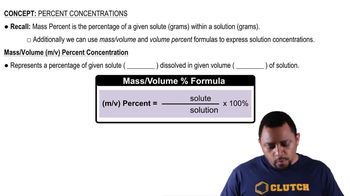
Percent Concentrations Concept 1

Calcium Ions (Ca²⁺)

Calcium ions (Ca²⁺) are positively charged ions that play vital roles in various physiological processes, including muscle contraction, nerve transmission, and blood coagulation. The concentration of Ca²⁺ in blood is tightly regulated, as both low and high levels can lead to significant health issues. Understanding its concentration helps in assessing and managing conditions related to calcium metabolism.
Recommended video:
Guided course
01:30
Ions and the Octet Rule (Simplified) Example 2

Electrolyte Balance

Electrolyte balance refers to the proper levels of ions in the body fluids, which are essential for maintaining homeostasis. Calcium is one of the key electrolytes, and its concentration affects many bodily functions. An imbalance can lead to symptoms such as muscle cramps, irregular heartbeats, or neurological issues, making it important to monitor and understand calcium levels in the blood.
Recommended video:
Guided course
00:34
Electrolytes (Simplified) Example 1