
Pearson+ LogoPearson+ Logo
Ch.9 Solutions
McMurry - Fundamentals of GOB 8th Edition
McMurry8th EditionFundamentals of GOBISBN: 9780134015187Not the one you use?Change textbook
Chapter 9, Problem 95b

Many compounds are only partially dissociated into ions in aqueous solution. Trichloroacetic acid (CCl3CO2H), for instance, is partially dissociated in water according to the equation
CCl3CO2H(aq) → H+(aq) + CCl3CO2⁻ aq)
For a solution prepared by dissolving 1.00 mol of trichloroacetic acid in 1.00 kg of water, 36.0% of the trichloroacetic acid dissociates to form H+ and CCl3CO2⁻ ions.
b. What is the freezing point of this solution? (The freezing point of 1 kg of water is lowered 1.86 °C for each mole of solute particles.)

Verified step by step guidance
1
Step 1: Calculate the number of moles of trichloroacetic acid (CCl₃CO₂H) that dissociate. Since 36.0% of the acid dissociates, multiply the initial moles of trichloroacetic acid (1.00 mol) by 0.36 to find the moles of dissociated acid.
Step 2: Determine the total number of solute particles in the solution. For every mole of trichloroacetic acid that dissociates, it produces 2 particles (1 H⁺ ion and 1 CCl₃CO₂⁻ ion). Add the moles of dissociated particles to the moles of undissociated trichloroacetic acid (which remains as 1 particle per mole). The total number of solute particles is the sum of these contributions.
Step 3: Calculate the molality (m) of the solution. Molality is defined as the number of moles of solute particles per kilogram of solvent. Use the total number of solute particles from Step 2 and divide by the mass of the solvent (1.00 kg of water).
Step 4: Use the freezing point depression formula to calculate the change in freezing point (ΔT_f). The formula is ΔT_f = i × K_f × m, where i is the van 't Hoff factor (the number of particles per formula unit, which you calculated in Step 2), K_f is the freezing point depression constant for water (1.86 °C·kg/mol), and m is the molality from Step 3.
Step 5: Subtract the freezing point depression (ΔT_f) from the normal freezing point of water (0.00 °C) to find the freezing point of the solution.

Verified video answer for a similar problem:

This video solution was recommended by our tutors as helpful for the problem above.
Video duration:
4m
Was this helpful?

Key Concepts

Here are the essential concepts you must grasp in order to answer the question correctly.

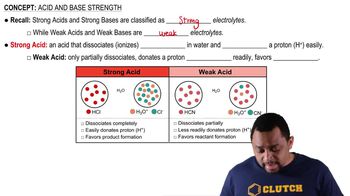
Dissociation of Acids

Dissociation refers to the process by which an acid separates into its constituent ions in solution. In the case of trichloroacetic acid, it partially dissociates into hydrogen ions (H⁺) and trichloroacetate ions (CCl₃CO₂⁻). Understanding the extent of dissociation is crucial for calculating the concentration of ions in solution, which directly affects properties like freezing point.
Recommended video:
Guided course
02:06
Acid and Base Strength Concept 1

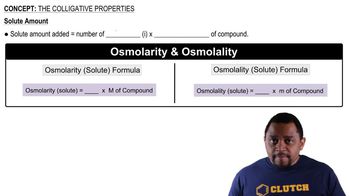
Colligative Properties

Colligative properties are physical properties of solutions that depend on the number of solute particles rather than their identity. Freezing point depression is one such property, where the presence of solute particles lowers the freezing point of a solvent. The formula for freezing point depression indicates that for each mole of solute particles, the freezing point decreases by a specific amount, which is essential for solving the given problem.
Recommended video:
Guided course
01:27
The Colligative Properties Concept 3

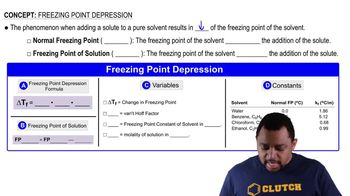
Freezing Point Depression Calculation

To calculate the freezing point depression, one must determine the total number of solute particles in the solution. For trichloroacetic acid, 36.0% dissociation means that from 1.00 mol of acid, 0.36 mol dissociates into 0.36 mol of H⁺ and 0.36 mol of CCl₃CO₂⁻, resulting in a total of 0.72 mol of particles. This total is then used in the freezing point depression formula to find the new freezing point of the solution.
Recommended video:
Guided course
02:00
Freezing Point Depression Concept 1
Related Practice
Textbook Question

Cobalt(II) chloride, a blue solid, can absorb water from the air to form cobalt(II) chloride hexahydrate, a pink solid. The equilibrium is so sensitive to moisture in the air that CoCl2 is used as a humidity indicator.

a. Write a balanced equation for the equilibrium. Be sure to include water as a reactant to produce the hexahydrate.

1985
views
Textbook Question

How many milliliters of 0.150 M BaCl2 are needed to react completely with 35.0 mL of 0.200 M Na2SO4? How many grams of BaSO4 will be formed?

1972
views
Textbook Question

Many compounds are only partially dissociated into ions in aqueous solution. Trichloroacetic acid (CCl3CO2H), for instance, is partially dissociated in water according to the equation

CCl3CO2H(aq) → H+(aq) + CCl3CO2⁻ aq)

For a solution prepared by dissolving 1.00 mol of trichloroacetic acid in 1.00 kg of water, 36.0% of the trichloroacetic acid dissociates to form H+ and CCl3CO2⁻ ions.

a. What is the total concentration of dissolved ions and molecules in 1 kg of water?

1627
views
Textbook Question

Hyperbaric chambers, which provide high pressures (up to 6 atm) of either air or pure oxygen, are used to treat a variety of conditions, ranging from decompression sickness in deep-sea divers to carbon monoxide poisoning. Look up the solubility of O2, N2, CO, and CO2 in water at standard temperature and pressure (1 atm, 25 °C).

a. Explain the trends in relative solubility for these gases.

1776
views
Textbook Question

Hyperbaric chambers, which provide high pressures (up to 6 atm) of either air or pure oxygen, are used to treat a variety of conditions, ranging from decompression sickness in deep-sea divers to carbon monoxide poisoning. Look up the solubility of O2, N2, CO, and CO2 in water at standard temperature and pressure (1 atm, 25 °C).

b. Explain how elevated pressures in a hyperbaric chamber be used to treat decompression sickness (excess N2 in blood) and carbon monoxide poisoning.

2430
views
Textbook Question

Look up the composition of Ringer's solution used in the treatment of burns and wounds.

b. What is the osmolarity of the solution? Is it hypertonic, isotonic, or hypotonic with blood plasma (0.30 osmol)? Discuss possible medicinal reasons for the osmolarity of the solution.

1786
views