Pearson+ LogoPearson+ Logo
Ch.12 Introduction to Organic Chemistry: Alkanes
McMurry - Fundamentals of GOB 8th Edition
McMurry8th EditionFundamentals of GOBISBN: 9780134015187Not the one you use?Change textbook
Chapter 12, Problem 41b

Give an example of a compound that meets the following descriptions:
b. A cycloalkane with three substituents

Verified step by step guidance
1
Step 1: Understand the definition of a cycloalkane. A cycloalkane is a type of hydrocarbon where carbon atoms are connected in a ring structure with only single bonds. Examples include cyclopropane, cyclobutane, and cyclohexane.
Step 2: Recognize that the problem specifies three substituents. Substituents are atoms or groups of atoms attached to the main ring structure. These can include alkyl groups (e.g., methyl, ethyl) or other functional groups.
Step 3: Choose a base cycloalkane structure. For simplicity, start with a common cycloalkane such as cyclohexane (a six-carbon ring) or cyclopentane (a five-carbon ring).
Step 4: Add three substituents to the ring. For example, you could attach a methyl group (-CH₃), an ethyl group (-C₂H₅), and a chlorine atom (-Cl) to different carbon atoms on the ring. Ensure the substituents are placed in a way that avoids ambiguity in naming (use IUPAC rules for naming if needed).
Step 5: Verify the structure meets the criteria. Confirm that the compound is a cycloalkane (ring structure with single bonds) and has exactly three substituents. An example compound could be 1-methyl-2-ethyl-3-chlorocyclopentane.

Verified video answer for a similar problem:

This video solution was recommended by our tutors as helpful for the problem above.
Was this helpful?

Key Concepts

Here are the essential concepts you must grasp in order to answer the question correctly.

Cycloalkanes

Cycloalkanes are a class of hydrocarbons characterized by a ring structure composed of carbon atoms. They are saturated compounds, meaning they contain only single bonds between carbon atoms. The simplest cycloalkane is cyclopropane, which consists of three carbon atoms in a triangular formation. Cycloalkanes can have various substituents attached to the ring, influencing their chemical properties and reactivity.
Recommended video:
Guided course
0:36
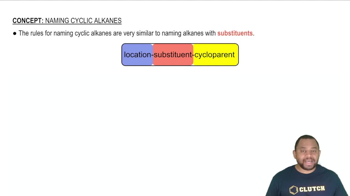
Rules for Naming Cyclic Alkanes Concept 1

Substituents

Substituents are atoms or groups of atoms that replace hydrogen atoms in a hydrocarbon structure. In the context of cycloalkanes, substituents can be alkyl groups, halogens, or functional groups that modify the properties of the compound. The presence and position of substituents on the cycloalkane can significantly affect its stability, reactivity, and physical properties, such as boiling and melting points.
Recommended video:
Guided course
5:07
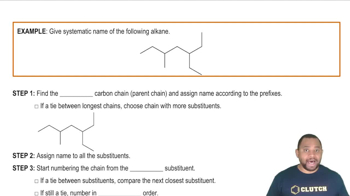
Naming Alkanes with Substituents Example 1

Nomenclature of Organic Compounds

The nomenclature of organic compounds follows specific rules set by the International Union of Pure and Applied Chemistry (IUPAC). For cycloalkanes with substituents, the naming involves identifying the main cycloalkane structure and numbering the carbon atoms to give the substituents the lowest possible numbers. This systematic approach ensures clarity and consistency in naming, allowing chemists to communicate effectively about complex organic molecules.
Recommended video:
Guided course
2:26
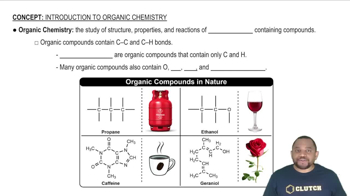
Introduction to Organic Chemistry Concept 1