Pearson+ LogoPearson+ Logo
Ch.12 Introduction to Organic Chemistry: Alkanes
McMurry - Fundamentals of GOB 8th Edition
McMurry8th EditionFundamentals of GOBISBN: 9780134015187Not the one you use?Change textbook
Chapter 12, Problem 37

If one compound has the formula C5H10 and another has the formula C4H10 are the two compounds isomers? Explain.

Verified step by step guidance
1
Step 1: Recall the definition of isomers. Isomers are compounds that have the same molecular formula but different structural arrangements of atoms.
Step 2: Compare the molecular formulas of the two compounds. The first compound has the formula C₅H₁₀, and the second compound has the formula C₄H₁₀. For two compounds to be isomers, their molecular formulas must be identical.
Step 3: Analyze the molecular formulas. The first compound has 5 carbon atoms and 10 hydrogen atoms, while the second compound has 4 carbon atoms and 10 hydrogen atoms. Since the number of carbon atoms differs, the molecular formulas are not the same.
Step 4: Conclude that because the molecular formulas are not identical, the two compounds cannot be isomers.
Step 5: Note that the difference in the number of carbon atoms indicates that these are entirely different compounds, not structural variations of the same molecular formula.

Verified video answer for a similar problem:

This video solution was recommended by our tutors as helpful for the problem above.
Was this helpful?

Key Concepts

Here are the essential concepts you must grasp in order to answer the question correctly.

Isomers

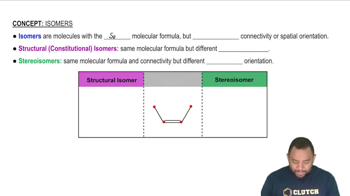
Isomers are compounds that have the same molecular formula but differ in the arrangement of atoms. This can lead to different structural or spatial configurations, resulting in distinct chemical properties. Understanding isomerism is crucial for distinguishing between compounds that may appear similar based on their formulas.
Recommended video:
Guided course
2:16
Isomers Concept 1

Molecular Formula

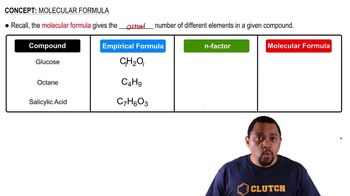
A molecular formula represents the number and types of atoms in a molecule, denoted by the symbols of the elements and subscripts indicating the quantity of each atom. For example, C₅H₁₀ indicates a molecule with five carbon atoms and ten hydrogen atoms. Comparing molecular formulas helps identify potential isomers and their structural variations.
Recommended video:
Guided course
02:08
Molecular Formula

Structural Isomers

Structural isomers are a specific type of isomer where the connectivity of atoms differs between compounds. This can include variations in the carbon skeleton or the position of functional groups. In the case of C₅H₁₀ and C₄H₁₀, understanding structural isomerism is essential to determine if they can exist as isomers based on their molecular formulas.
Recommended video:
Guided course
2:16
Isomers Concept 1