Pearson+ LogoPearson+ Logo
Ch.12 Introduction to Organic Chemistry: Alkanes
McMurry - Fundamentals of GOB 8th Edition
McMurry8th EditionFundamentals of GOBISBN: 9780134015187Not the one you use?Change textbook
Chapter 12, Problem 34c

Propose structures for molecules that fit the following descriptions:
(c) A compound with the formula C3H7NOS that is both an amide and a thiol

Verified step by step guidance
1
Step 1: Understand the molecular formula C3H7NOS. This indicates the molecule contains 3 carbon atoms, 7 hydrogen atoms, 1 nitrogen atom, 1 oxygen atom, and 1 sulfur atom.
Step 2: Recall the functional groups involved. An amide group contains a carbonyl group (C=O) directly bonded to a nitrogen atom (N). A thiol group contains a sulfur atom bonded to a hydrogen atom (-SH).
Step 3: Arrange the atoms to include both functional groups. Start by placing the amide group in the structure. For example, you can have a carbon atom double-bonded to an oxygen atom and single-bonded to a nitrogen atom.
Step 4: Add the thiol group (-SH) to the structure. Ensure that the sulfur atom is bonded to a carbon atom in the molecule, and the hydrogen atom is attached to the sulfur atom.
Step 5: Verify the structure. Ensure the total number of atoms matches the molecular formula (C3H7NOS) and that the molecule contains both the amide and thiol functional groups. Adjust the connectivity of the remaining carbon and hydrogen atoms to satisfy the valency of each atom.

Verified video answer for a similar problem:

This video solution was recommended by our tutors as helpful for the problem above.
Was this helpful?

Key Concepts

Here are the essential concepts you must grasp in order to answer the question correctly.

Amides

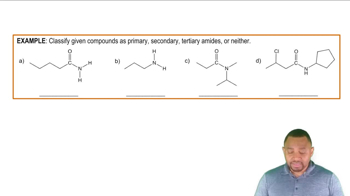
Amides are organic compounds derived from carboxylic acids where the hydroxyl group is replaced by an amine or ammonia. They typically have the functional group -C(=O)N-, where a carbonyl (C=O) is bonded to a nitrogen atom. Amides are important in biochemistry, as they are found in proteins and peptides, and they can influence the properties of molecules significantly.
Recommended video:
Guided course
1:03
Intro to Amides Example 1

Thiol

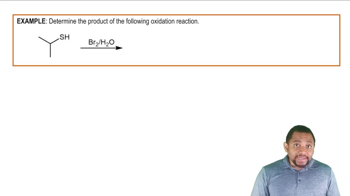
Thiol compounds contain a sulfur atom bonded to a hydrogen atom, represented by the functional group -SH. They are analogous to alcohols, where the oxygen is replaced by sulfur. Thiols are known for their strong odors and are important in various biological processes, including the formation of disulfide bonds in proteins, which can affect protein structure and function.
Recommended video:
Guided course
0:53
Reactions of Thiols Example 1

Molecular Structure and Isomerism

Molecular structure refers to the arrangement of atoms within a molecule, which can significantly influence its chemical properties and reactivity. Isomerism occurs when compounds have the same molecular formula but different structural arrangements. Understanding isomerism is crucial for proposing valid structures for compounds like C3H7NOS, as different arrangements can lead to distinct functional groups and properties.
Recommended video:
Guided course
00:34
Molecular Models Example 1