Pearson+ LogoPearson+ Logo
Ch.13 Alkenes, Alkynes, and Aromatic Compounds
McMurry - Fundamentals of GOB 8th Edition
McMurry8th EditionFundamentals of GOBISBN: 9780134015187Not the one you use?Change textbook
Chapter 13, Problem 34a

Write structural formulas for compounds that meet the following descriptions:
a. A 6-carbon alkene whose longest chain is 4 carbons in length (three possibilities)

Verified step by step guidance
1
Step 1: Understand the problem. You are tasked with writing structural formulas for three different compounds that meet the description of a 6-carbon alkene with the longest chain being 4 carbons. An alkene is a hydrocarbon containing at least one double bond.
Step 2: Begin by identifying the main chain. The longest chain must be 4 carbons, so draw a straight chain of 4 carbons (C-C-C-C). This will serve as the backbone of the molecule.
Step 3: Add the double bond to the main chain. Since the compound is an alkene, place the double bond between two adjacent carbons in the main chain. For example, you can place the double bond between the first and second carbons, or between the second and third carbons.
Step 4: Add substituents to the main chain to ensure the total number of carbons in the molecule is 6. For instance, you can add methyl groups (-CH₃) to the remaining carbons in different positions to create structural isomers. Ensure the substituents do not extend the main chain beyond 4 carbons.
Step 5: Verify the structures. Check that each structure has exactly 6 carbons, contains a double bond (making it an alkene), and has a longest chain of 4 carbons. Draw the structural formulas for each possibility, ensuring they are distinct isomers.

Verified video answer for a similar problem:

This video solution was recommended by our tutors as helpful for the problem above.
Was this helpful?

Key Concepts

Here are the essential concepts you must grasp in order to answer the question correctly.

Alkene Structure

Alkenes are hydrocarbons that contain at least one carbon-carbon double bond. They follow the general formula CnH2n, where 'n' is the number of carbon atoms. The presence of the double bond affects the compound's reactivity and physical properties, making it distinct from alkanes, which only have single bonds.
Recommended video:
Guided course
3:26
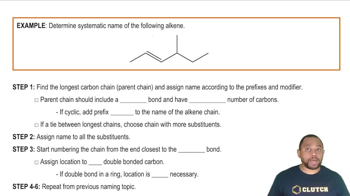
Naming Alkenes Example 1

Structural Formula

A structural formula represents the arrangement of atoms within a molecule, showing how the atoms are bonded to each other. It provides insight into the connectivity and geometry of the molecule, which is crucial for understanding its chemical behavior. In the case of alkenes, the position of the double bond is particularly important.
Recommended video:
Guided course
1:01
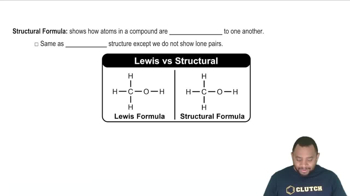
Structural Formula Concept 2

Isomerism in Alkenes

Isomerism occurs when compounds have the same molecular formula but different structural arrangements. For alkenes, this can include positional isomers, where the location of the double bond varies, and geometric isomers, which arise from the restricted rotation around the double bond. Understanding isomerism is essential for identifying all possible structural formulas for a given alkene.
Recommended video:
Guided course
3:26
Naming Alkenes Example 1