Pearson+ LogoPearson+ Logo
Ch.14 Some Compounds with Oxygen, Sulfur, or a Halogen
McMurry - Fundamentals of GOB 8th Edition
McMurry8th EditionFundamentals of GOBISBN: 9780134015187Not the one you use?Change textbook
Chapter 14, Problem 17

What disulfides would you obtain from oxidation of the following thiols?
a. CH3CH2CH2SH
b. 3-Methyl-1-butanethiol (skunk scent)

Verified step by step guidance
1
Step 1: Understand the reaction. The oxidation of thiols (R-SH) leads to the formation of disulfides (R-S-S-R). This reaction involves the removal of hydrogen atoms from two thiol molecules and the formation of a covalent bond between the sulfur atoms.
Step 2: Write the general reaction for thiol oxidation. For a thiol molecule R-SH, the oxidation reaction can be represented as: 2R-SHR-S-S-R+H_2. This shows that two thiol molecules combine to form one disulfide molecule.
Step 3: Apply the reaction to part (a). For CH₃CH₂CH₂SH (1-propanethiol), two molecules of this thiol will react to form the disulfide. The product will be CH₃CH₂CH₂-S-S-CH₂CH₂CH₃ (1,1'-dithiobispropane).
Step 4: Apply the reaction to part (b). For 3-methyl-1-butanethiol, two molecules of this thiol will react to form the disulfide. The product will be 3-methyl-1-butanethiol disulfide, with the structure CH₃CH₂CH(CH₃)-S-S-CH(CH₃)CH₂CH₃.
Step 5: Verify the products. Ensure that the products are correctly named and that the sulfur atoms are bonded to each other in the disulfide linkage. The oxidation process does not alter the carbon backbone of the original thiol molecules.

Verified video answer for a similar problem:

This video solution was recommended by our tutors as helpful for the problem above.
Was this helpful?

Key Concepts

Here are the essential concepts you must grasp in order to answer the question correctly.

Disulfide Formation

Disulfide formation occurs when two thiol groups (-SH) undergo oxidation, resulting in the creation of a covalent bond between the sulfur atoms, forming a disulfide bond (-S-S-). This reaction is crucial in biochemistry, as disulfides play a significant role in stabilizing protein structures.
Recommended video:
Guided course
1:41
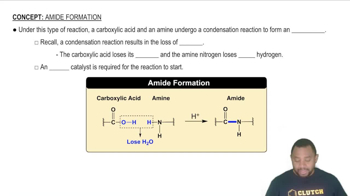
Amide Formation Concept 1

Oxidation of Thiols

Oxidation of thiols involves the loss of electrons or hydrogen atoms from the thiol group, leading to the formation of disulfides. This process can be facilitated by various oxidizing agents and is essential in understanding the reactivity of thiols in organic chemistry.
Recommended video:
Guided course
0:53
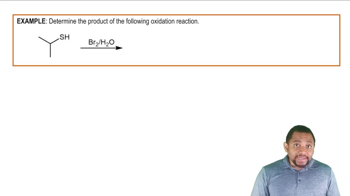
Reactions of Thiols Example 1

Structural Isomers and Their Properties

Structural isomers, like 3-methyl-1-butanethiol, have the same molecular formula but different arrangements of atoms. Understanding the structural differences is important as they can influence the reactivity and properties of the thiols, affecting the types of disulfides formed during oxidation.
Recommended video:
Guided course
2:16
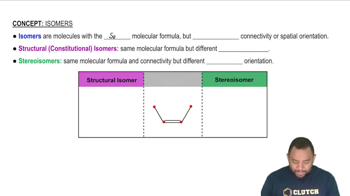
Isomers Concept 1