Pearson+ LogoPearson+ Logo
Ch.16 Amines
McMurry - Fundamentals of GOB 8th Edition
McMurry8th EditionFundamentals of GOBISBN: 9780134015187Not the one you use?Change textbook
Chapter 16, Problem 15

Which is the stronger base in each pair?
a. Ammonia or ethylamine
b.Triethylamine or pyridine

Verified step by step guidance
1
Step 1: Understand the concept of base strength. A stronger base has a greater ability to accept protons (H⁺). In organic chemistry, the strength of a base is influenced by the availability of the lone pair of electrons on the nitrogen atom and the surrounding molecular structure.
Step 2: Analyze part (a): Ammonia (NH₃) vs. Ethylamine (CH₃CH₂NH₂). Ethylamine is an amine with an ethyl group attached to the nitrogen. The ethyl group is an electron-donating group, which increases the electron density on the nitrogen atom, making it more available to accept a proton. Ammonia lacks such an electron-donating group, so its nitrogen is less nucleophilic.
Step 3: Conclude for part (a): Ethylamine is the stronger base compared to ammonia because the electron-donating ethyl group enhances the basicity of the nitrogen atom.
Step 4: Analyze part (b): Triethylamine ((CH₃CH₂)₃N) vs. Pyridine (C₅H₅N). Triethylamine has three ethyl groups attached to the nitrogen, which significantly increase the electron density on the nitrogen, enhancing its basicity. Pyridine, on the other hand, is an aromatic compound where the lone pair of electrons on the nitrogen is delocalized into the aromatic ring, reducing its availability to accept a proton.
Step 5: Conclude for part (b): Triethylamine is the stronger base compared to pyridine because the lone pair on the nitrogen in triethylamine is more available for protonation, while in pyridine, the lone pair is partially delocalized into the aromatic system.

Verified video answer for a similar problem:

This video solution was recommended by our tutors as helpful for the problem above.
Was this helpful?

Key Concepts

Here are the essential concepts you must grasp in order to answer the question correctly.

Basicity

Basicity refers to the ability of a substance to accept protons (H+) or donate electron pairs. In organic chemistry, stronger bases are typically characterized by their ability to stabilize the positive charge that results from protonation. The strength of a base can be influenced by factors such as electronegativity, steric hindrance, and resonance effects.
Recommended video:
Guided course
01:04
Balancing Redox Reactions: Basic Solutions

Amine Structure

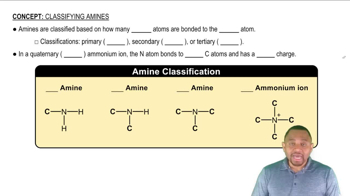
Amines are organic compounds derived from ammonia by replacing one or more hydrogen atoms with alkyl or aryl groups. The structure of an amine affects its basicity; for instance, primary and secondary amines are generally stronger bases than tertiary amines due to steric hindrance that can impede protonation. The presence of electron-donating groups can also enhance basicity.
Recommended video:
Guided course
1:26
Amine Classification Concept 1

Resonance and Electron Delocalization

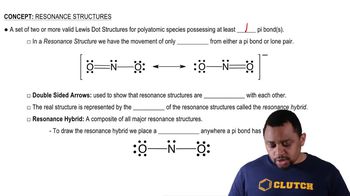
Resonance involves the delocalization of electrons across multiple atoms, which can stabilize or destabilize a molecule. In the context of basicity, if a base's lone pair of electrons is involved in resonance with other atoms, it may be less available to accept protons, thus reducing its basicity. Understanding resonance structures helps predict the relative strengths of bases in different pairs.
Recommended video:
Guided course
01:59
Resonance Structures (Simplified) Concept 1