Pearson+ LogoPearson+ Logo
Ch.18 Amino Acids and Proteins
McMurry - Fundamentals of GOB 8th Edition
McMurry8th EditionFundamentals of GOBISBN: 9780134015187Not the one you use?Change textbook
Chapter 18, Problem 93c

Explain how a protein is denatured by the following:
c. Organic solvents

Verified step by step guidance
1
Understand the concept of protein denaturation: Denaturation is the process in which a protein loses its native three-dimensional structure due to the disruption of non-covalent interactions, such as hydrogen bonds, ionic bonds, and hydrophobic interactions. This process does not break peptide bonds but alters the protein's functional shape.
Recognize the role of organic solvents: Organic solvents, such as ethanol or acetone, are capable of disrupting the hydrophobic interactions within a protein. These interactions are critical for maintaining the protein's tertiary structure, as hydrophobic side chains are typically buried in the interior of the protein to avoid contact with water.
Explain the mechanism of disruption: Organic solvents reduce the polarity of the surrounding environment, making it less favorable for hydrophobic side chains to remain buried. This causes the hydrophobic regions of the protein to unfold and become exposed to the solvent, leading to a loss of the protein's native structure.
Consider the impact on hydrogen bonding: Organic solvents can also interfere with hydrogen bonding by competing with water molecules or directly interacting with polar groups in the protein. This further destabilizes the protein's secondary and tertiary structures.
Summarize the result: The combined effects of disrupted hydrophobic interactions and hydrogen bonding lead to the unfolding of the protein, rendering it non-functional. This process is reversible or irreversible depending on the specific protein and conditions.

Verified video answer for a similar problem:

This video solution was recommended by our tutors as helpful for the problem above.
Was this helpful?

Key Concepts

Here are the essential concepts you must grasp in order to answer the question correctly.

Protein Structure

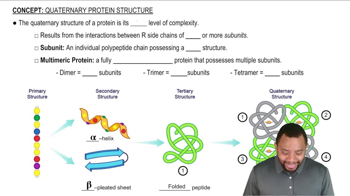
Proteins are composed of long chains of amino acids that fold into specific three-dimensional structures. These structures are crucial for their function and are categorized into four levels: primary, secondary, tertiary, and quaternary. The stability of these structures is maintained by various interactions, including hydrogen bonds, ionic bonds, and hydrophobic interactions.
Recommended video:
Guided course
3:26
Quaternary Protein Structure Concept 1

Denaturation

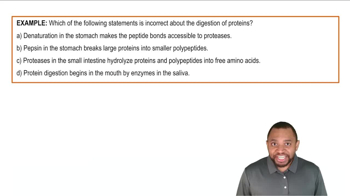
Denaturation refers to the process where a protein loses its native structure due to external stressors, such as heat, pH changes, or chemical agents. This alteration disrupts the interactions that maintain the protein's shape, leading to a loss of function. Denatured proteins may aggregate or precipitate, rendering them biologically inactive.
Recommended video:
Guided course
1:17
Digestion of Proteins Example 1

Organic Solvents

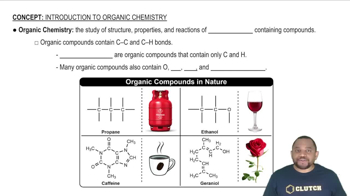
Organic solvents, such as ethanol or acetone, can disrupt the hydrophobic interactions within proteins. These solvents can solvate nonpolar amino acid side chains, leading to the unfolding of the protein structure. The presence of organic solvents can also alter the protein's environment, further promoting denaturation and affecting its solubility and functionality.
Recommended video:
Guided course
2:26
Introduction to Organic Chemistry Concept 1