
Pearson+ LogoPearson+ Logo
Ch.18 Amino Acids and Proteins
McMurry - Fundamentals of GOB 8th Edition
McMurry8th EditionFundamentals of GOBISBN: 9780134015187Not the one you use?Change textbook
Chapter 18, Problem 99

Oxytocin is a small peptide that is used to induce labor by causing contractions in uterine walls. It has the primary structure Cys-Tyr-Ile-Gln-Asn-Cys-Pro-Leu-Gln. This peptide is held in a cyclic configuration by a disulfide bridge. Draw a diagram of oxytocin, showing the disulfide bridge.

Verified step by step guidance
1
Understand the structure of oxytocin: Oxytocin is a peptide composed of nine amino acids (Cys-Tyr-Ile-Gln-Asn-Cys-Pro-Leu-Gln) arranged in a specific sequence. The peptide chain is held in a cyclic configuration by a disulfide bridge formed between the two cysteine residues.
Recall the structure of a disulfide bridge: A disulfide bridge is a covalent bond formed between the sulfur atoms of two cysteine residues. This bond stabilizes the three-dimensional structure of the peptide.
Draw the linear peptide chain: Begin by sketching the sequence of amino acids in the order provided (Cys-Tyr-Ile-Gln-Asn-Cys-Pro-Leu-Gln). Represent each amino acid with its side chain and backbone structure, ensuring the peptide bonds are correctly shown.
Add the disulfide bridge: Identify the two cysteine residues in the sequence. Connect the sulfur atoms of their side chains with a covalent bond to represent the disulfide bridge, creating the cyclic structure of oxytocin.
Finalize the diagram: Ensure that all atoms are correctly represented, including the hydrogen atoms, oxygen atoms, and nitrogen atoms in the peptide backbone. Label the disulfide bridge and confirm that the cyclic structure is complete and accurate.

Verified video answer for a similar problem:

This video solution was recommended by our tutors as helpful for the problem above.
Was this helpful?

Key Concepts

Here are the essential concepts you must grasp in order to answer the question correctly.

Oxytocin Structure

Oxytocin is a nonapeptide hormone composed of nine amino acids, specifically Cys-Tyr-Ile-Gln-Asn-Cys-Pro-Leu-Gln. Its structure is crucial for its biological function, particularly in inducing labor by stimulating uterine contractions. Understanding the sequence and arrangement of these amino acids is essential for visualizing its molecular structure.
Recommended video:
Guided course
1:01
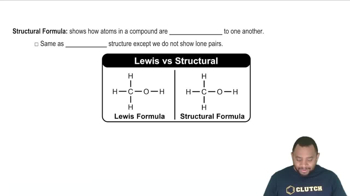
Structural Formula Concept 2

Disulfide Bridge

A disulfide bridge is a covalent bond formed between the sulfur atoms of two cysteine residues in a protein or peptide. In oxytocin, this bridge stabilizes its cyclic configuration, which is important for its activity and interaction with receptors. Recognizing the role of disulfide bridges helps in understanding the stability and functionality of peptide hormones.
Recommended video:
Guided course
2:41
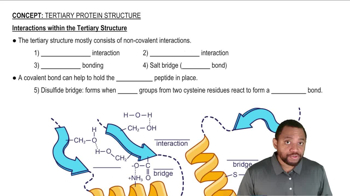
Interactions within the Tertiary Structure Concept 2

Peptide Diagramming

Diagramming a peptide involves representing its amino acid sequence and structural features, such as disulfide bridges. This visual representation aids in comprehending the spatial arrangement of atoms and the overall conformation of the molecule. Accurate diagramming is essential for illustrating how structural elements contribute to the peptide's biological role.
Recommended video:
Guided course
1:24
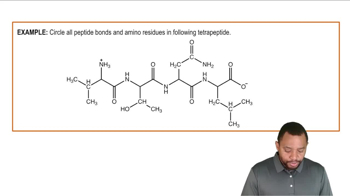
Peptides Example 1
Related Practice
Textbook Question

Fresh pineapple cannot be used in gelatin desserts because it contains an enzyme that hydrolyzes the proteins in gelatin, destroying the gelling action. Canned pineapple can be added to gelatin with no problem. Why?

Textbook Question

As a chef, you prepare a wide variety of foods daily. The following dishes all contain protein. What method (if any) has been used to denature the protein present in each food?

a. Charcoal-grilled steak

Textbook Question

For each amino acid listed, tell whether its influence on tertiary structure is largely through hydrophobic interactions, hydrogen bonding, formation of salt bridges, covalent bonding, or some combination of these effects.

a. Tyrosine

848
views
Textbook Question

Four of the most abundant amino acids in proteins are leucine, alanine, glycine, and valine. What do these amino acids have in common? Would you expect these amino acids to be found on the interior or on the exterior of the protein?

873
views
Textbook Question

Globular proteins are water-soluble, whereas fibrous proteins are insoluble in water. Indicate whether you expect the following amino acids to be on the surface of a globular protein or on the surface of a fibrous protein.

a. Ala

871
views
Textbook Question

A family visits a pediatrician with their sick child. The four-month-old baby is pale, has obvious episodes of pain, and is not thriving. The doctor orders a series of blood tests, including a test for hemoglobin types. The results show that the infant is not only anemic but that the anemia is due to sickle-cell anemia. The family wants to know if their other two children have sickle-cell anemia, sickle-cell trait, or no sickle-cell gene at all.

a. What test will be used?

730
views