Pearson+ LogoPearson+ Logo
Ch.19 Enzymes and Vitamins
McMurry - Fundamentals of GOB 8th Edition
McMurry8th EditionFundamentals of GOBISBN: 9780134015187Not the one you use?Change textbook
Chapter 19, Problem 14

What kind of reaction product might be a competitive inhibitor for the enzyme that catalyzes its formation?

Verified step by step guidance
1
Understand the concept of competitive inhibition: A competitive inhibitor is a molecule that resembles the substrate of an enzyme and competes with the substrate for binding to the enzyme's active site. This prevents the enzyme from catalyzing the reaction effectively.
Recognize the relationship between the reaction product and the enzyme: The product of an enzymatic reaction often has structural similarities to the substrate because it is derived from the substrate through the enzyme's catalytic activity.
Consider how the product might act as a competitive inhibitor: If the product has a structure similar to the substrate, it can bind to the enzyme's active site, blocking the substrate from binding and thus inhibiting the enzyme's activity.
Analyze the feedback mechanism: In some biochemical pathways, the product of a reaction acts as a natural competitive inhibitor to regulate the enzyme's activity and prevent overproduction of the product. This is a form of feedback inhibition.
Conclude that the reaction product might be a competitive inhibitor if it structurally resembles the substrate and can bind to the enzyme's active site, thereby competing with the substrate for access to the enzyme.

Verified video answer for a similar problem:

This video solution was recommended by our tutors as helpful for the problem above.
Video duration:
1m
Was this helpful?

Key Concepts

Here are the essential concepts you must grasp in order to answer the question correctly.

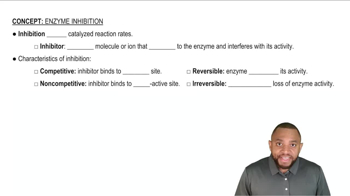
Competitive Inhibition

Competitive inhibition occurs when a molecule similar in structure to the substrate competes for binding at the active site of an enzyme. This type of inhibition can be overcome by increasing the concentration of the substrate, as the inhibitor and substrate vie for the same binding site. Understanding this concept is crucial for identifying how certain reaction products can inhibit enzyme activity.
Recommended video:
Guided course
1:19
Enzyme Inhibition Concept 1

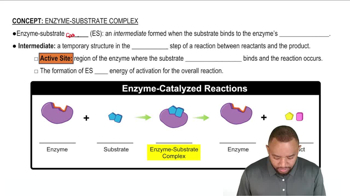
Enzyme-Substrate Complex

The enzyme-substrate complex is formed when an enzyme binds to its specific substrate, facilitating a chemical reaction. This complex is essential for the enzyme's catalytic activity, as it lowers the activation energy required for the reaction. Recognizing how this complex forms helps in understanding how a competitive inhibitor can disrupt the reaction process.
Recommended video:
Guided course
2:32
Enzyme-Substrate Complex Concept 1

Reaction Product

A reaction product is the substance that results from the enzymatic conversion of a substrate during a biochemical reaction. In the context of competitive inhibition, the reaction product can sometimes resemble the substrate closely enough to bind to the enzyme's active site, thereby inhibiting the enzyme's function. This concept is vital for analyzing how certain products can act as inhibitors.
Recommended video:
Guided course
1:08
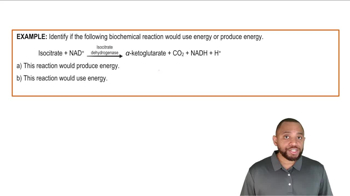
Energy Production In Biochemical Pathways Example 1