Pearson+ LogoPearson+ Logo
Ch.21 The Generation of Biochemical Energy
McMurry - Fundamentals of GOB 8th Edition
McMurry8th EditionFundamentals of GOBISBN: 9780134015187Not the one you use?Change textbook
Chapter 21, Problem 85b

The citric acid cycle contains four 4-carbon dicarboxylic acids.
b. Arrange them in order from least oxidized to most oxidized.

Verified step by step guidance
1
Identify the four 4-carbon dicarboxylic acids involved in the citric acid cycle: succinate, fumarate, malate, and oxaloacetate. These compounds differ in their oxidation states.
Understand the concept of oxidation: Oxidation involves the loss of electrons, which often corresponds to an increase in the number of bonds to oxygen or a decrease in the number of bonds to hydrogen in organic molecules.
Analyze the structure of each compound: Succinate has no double bonds and is the least oxidized. Fumarate has a double bond between two carbons, indicating a higher oxidation state. Malate has a hydroxyl (-OH) group, which is more oxidized than fumarate. Oxaloacetate has a ketone group (C=O), making it the most oxidized.
Arrange the compounds in order of increasing oxidation: Start with succinate (least oxidized), followed by fumarate, then malate, and finally oxaloacetate (most oxidized).
Verify the order by comparing the functional groups and oxidation states of each compound to ensure the sequence aligns with the principles of oxidation in organic chemistry.

Verified video answer for a similar problem:

This video solution was recommended by our tutors as helpful for the problem above.
Video duration:
6m
Was this helpful?

Key Concepts

Here are the essential concepts you must grasp in order to answer the question correctly.

Citric Acid Cycle

The citric acid cycle, also known as the Krebs cycle, is a key metabolic pathway that occurs in the mitochondria. It plays a crucial role in cellular respiration by oxidizing acetyl-CoA to produce energy in the form of ATP, as well as electron carriers like NADH and FADH2. Understanding this cycle is essential for analyzing the oxidation states of the compounds involved.
Recommended video:
Guided course
2:31
Citric Acid Cycle Summary Concept 12

Oxidation States

Oxidation states refer to the degree of oxidation of an atom in a chemical compound, indicating how many electrons have been lost or gained. In the context of the citric acid cycle, the oxidation state helps determine the relative reactivity and energy content of the dicarboxylic acids. Recognizing the changes in oxidation states throughout the cycle is vital for arranging the acids from least to most oxidized.
Recommended video:
Guided course
01:01
States of Matter Example 1

Dicarboxylic Acids

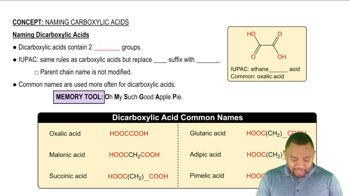
Dicarboxylic acids are organic compounds that contain two carboxyl (-COOH) groups. In the citric acid cycle, four key dicarboxylic acids are involved: oxaloacetate, succinate, fumarate, and malate. Understanding their structures and how they interconvert during the cycle is important for determining their oxidation levels and arranging them accordingly.
Recommended video:
Guided course
2:21
Naming Dicarboxylic Acids Concept 3