Pearson+ LogoPearson+ Logo
Ch.21 The Generation of Biochemical Energy
McMurry - Fundamentals of GOB 8th Edition
McMurry8th EditionFundamentals of GOBISBN: 9780134015187Not the one you use?Change textbook
Chapter 21, Problem 83

The mitochondrion pumps H+ from the matrix into the intermembrane space. Which region is more acidic, the matrix or the intermembrane space? Why?

Verified step by step guidance
1
Understand the concept of pH and acidity: Acidity is determined by the concentration of hydrogen ions (H+). A region with a higher concentration of H+ ions is more acidic and has a lower pH value.
Recognize the role of the mitochondrion: The mitochondrion actively pumps H+ ions from the matrix into the intermembrane space during cellular respiration, specifically in the electron transport chain.
Compare the regions: Since H+ ions are being moved from the matrix to the intermembrane space, the intermembrane space will have a higher concentration of H+ ions compared to the matrix.
Conclude which region is more acidic: The intermembrane space is more acidic because it has a higher concentration of H+ ions, resulting in a lower pH compared to the matrix.
Explain the significance: This H+ gradient is crucial for ATP synthesis, as the flow of H+ back into the matrix through ATP synthase drives the production of ATP in the process of oxidative phosphorylation.

Verified video answer for a similar problem:

This video solution was recommended by our tutors as helpful for the problem above.
Video duration:
2m
Was this helpful?

Key Concepts

Here are the essential concepts you must grasp in order to answer the question correctly.

Mitochondrial Structure

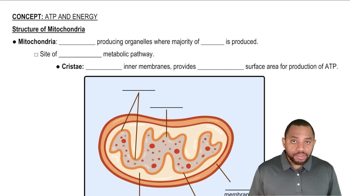
The mitochondrion consists of two membranes: the outer membrane and the inner membrane, which encloses the mitochondrial matrix. The space between these membranes is known as the intermembrane space. Understanding this structure is crucial for analyzing how protons (H<sup>+</sup>) are transported and how this affects the acidity of different regions.
Recommended video:
Guided course
1:46
Structure of Mitochondria Concept 1

Proton Gradient and pH

A proton gradient is created when protons are pumped from the mitochondrial matrix into the intermembrane space, leading to a higher concentration of H<sup>+</sup> ions in the intermembrane space. This increase in proton concentration lowers the pH, making the intermembrane space more acidic compared to the matrix, which has a lower concentration of protons.
Recommended video:
Guided course
02:09
pH and pOH Calculations

Acidity and pH Scale

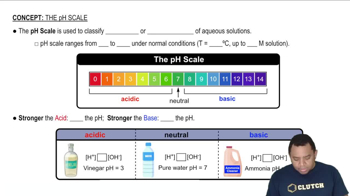
Acidity is measured using the pH scale, where lower pH values indicate higher acidity. The pH scale ranges from 0 to 14, with values below 7 being acidic. In the context of the mitochondrion, the intermembrane space, having a higher concentration of protons due to the pumping action, will have a lower pH and thus be more acidic than the matrix.
Recommended video: