Pearson+ LogoPearson+ Logo
Ch.21 The Generation of Biochemical Energy
McMurry - Fundamentals of GOB 8th Edition
McMurry8th EditionFundamentals of GOBISBN: 9780134015187Not the one you use?Change textbook
Chapter 21, Problem 69

What does the term “oxidative phosphorylation” mean? What is substrate-level phosphorylation? Are these processes the same? Explain.

Verified step by step guidance
1
Oxidative phosphorylation is a process that occurs in the mitochondria during cellular respiration. It involves the production of ATP (adenosine triphosphate) using energy derived from the transfer of electrons through the electron transport chain (ETC) and the subsequent movement of protons across the inner mitochondrial membrane, creating a proton gradient.
The energy from the proton gradient is used by the enzyme ATP synthase to convert ADP (adenosine diphosphate) and inorganic phosphate (Pi) into ATP. This process is dependent on oxygen as the final electron acceptor in the ETC, which is why it is called 'oxidative' phosphorylation.
Substrate-level phosphorylation, on the other hand, is a different mechanism of ATP production. It occurs directly in metabolic pathways such as glycolysis and the citric acid cycle, where a phosphate group is transferred from a high-energy substrate molecule to ADP to form ATP. This process does not require oxygen or the electron transport chain.
These two processes are not the same. Oxidative phosphorylation relies on the electron transport chain and a proton gradient, while substrate-level phosphorylation involves direct enzymatic transfer of a phosphate group from a substrate to ADP.
In summary, oxidative phosphorylation is a more complex, oxygen-dependent process that produces the majority of ATP in aerobic organisms, whereas substrate-level phosphorylation is a simpler, oxygen-independent process that contributes smaller amounts of ATP during specific metabolic steps.

Verified video answer for a similar problem:

This video solution was recommended by our tutors as helpful for the problem above.
Video duration:
1m
Was this helpful?

Key Concepts

Here are the essential concepts you must grasp in order to answer the question correctly.

Oxidative Phosphorylation

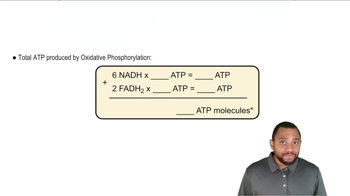
Oxidative phosphorylation is a metabolic process that occurs in the mitochondria, where ATP is produced through the transfer of electrons from NADH and FADH2 to oxygen via the electron transport chain. This process generates a proton gradient across the mitochondrial membrane, which drives ATP synthesis through ATP synthase. It is a key component of cellular respiration and is highly efficient in energy production.
Recommended video:
Guided course
0:51
Oxidative Phosphorylation Concept 2

Substrate-Level Phosphorylation

Substrate-level phosphorylation is a method of generating ATP directly from a substrate molecule during metabolic reactions, without the involvement of an electron transport chain. This process occurs in glycolysis and the citric acid cycle, where a phosphate group is transferred from a high-energy substrate to ADP, forming ATP. It is a simpler and less efficient way of producing ATP compared to oxidative phosphorylation.
Recommended video:
Guided course
0:51
Oxidative Phosphorylation Concept 2

Comparison of Phosphorylation Processes

While both oxidative phosphorylation and substrate-level phosphorylation are mechanisms for ATP production, they differ significantly in their processes and efficiency. Oxidative phosphorylation relies on the electron transport chain and oxygen, producing a larger yield of ATP, whereas substrate-level phosphorylation occurs independently of oxygen and generates ATP in smaller amounts. Understanding these differences is crucial for grasping cellular energy metabolism.
Recommended video:
Guided course
0:51
Oxidative Phosphorylation Concept 2