Pearson+ LogoPearson+ Logo
Ch.21 The Generation of Biochemical Energy
McMurry - Fundamentals of GOB 8th Edition
McMurry8th EditionFundamentals of GOBISBN: 9780134015187Not the one you use?Change textbook
Chapter 21, Problem 64c

What do the following abbreviations stand for?
c. NADH/H+

Verified step by step guidance
1
NADH/H⁺ stands for Nicotinamide Adenine Dinucleotide in its reduced form (NADH) along with a proton (H⁺).
NADH is a coenzyme that plays a critical role in redox reactions, acting as an electron carrier in metabolic pathways such as glycolysis, the citric acid cycle, and oxidative phosphorylation.
The 'H⁺' indicates that the molecule is associated with a proton, which is often involved in the transfer of electrons and protons during biochemical reactions.
NAD⁺ (oxidized form) accepts two electrons and one proton to become NADH (reduced form), which can then donate these electrons in subsequent reactions.
This process is essential for energy production in cells, as NADH is used to generate ATP in the electron transport chain.

Verified video answer for a similar problem:

This video solution was recommended by our tutors as helpful for the problem above.
Video duration:
3m
Was this helpful?

Key Concepts

Here are the essential concepts you must grasp in order to answer the question correctly.

NADH

NADH stands for Nicotinamide Adenine Dinucleotide (reduced form). It is a coenzyme found in all living cells, playing a crucial role in metabolic processes, particularly in cellular respiration. NADH acts as an electron carrier, transferring electrons from one reaction to another, which is essential for the production of ATP, the energy currency of the cell.
Recommended video:
Guided course
2:21
Total Energy From Glucose Example 1

H⁺

H⁺ represents a hydrogen ion, which is a proton that has lost its electron. In biochemical contexts, H⁺ ions are important for maintaining pH balance and are involved in various metabolic processes, including the electron transport chain. The concentration of H⁺ ions can influence enzyme activity and energy production in cells.
Recommended video:
Guided course
1:25
Hydrolysis of Glycosidic Linkage Example 2

Redox Reactions

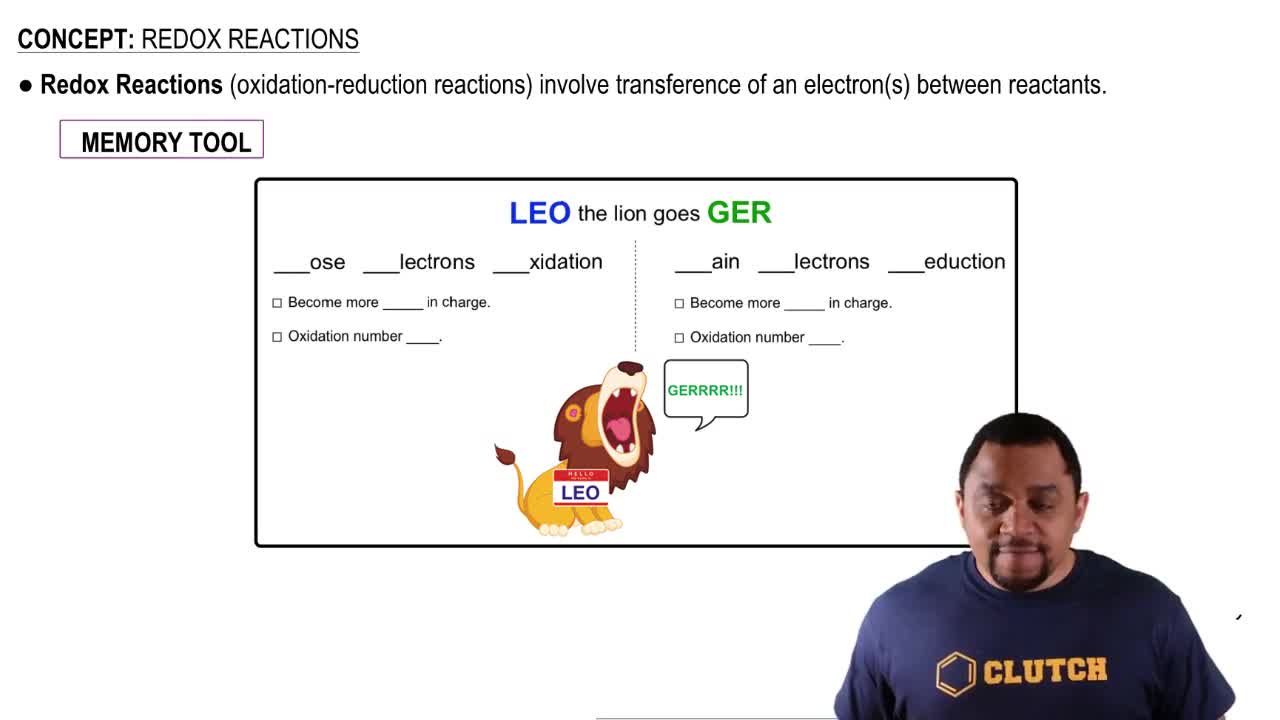
Redox reactions, short for reduction-oxidation reactions, are chemical processes that involve the transfer of electrons between two substances. In these reactions, one substance is oxidized (loses electrons) while the other is reduced (gains electrons). NADH plays a key role in redox reactions by accepting electrons during metabolic processes, thus facilitating energy production in cells.
Recommended video:
Guided course
01:53
Redox Reactions