Pearson+ LogoPearson+ Logo
Ch.21 The Generation of Biochemical Energy
McMurry - Fundamentals of GOB 8th Edition
McMurry8th EditionFundamentals of GOBISBN: 9780134015187Not the one you use?Change textbook
Chapter 21, Problem 65

What atom in the cytochromes undergoes oxidation and reduction in the electron-transport chain? What atoms in coenzyme Q undergo oxidation and reduction in the electron-transport chain?

Verified step by step guidance
1
Understand the role of cytochromes in the electron-transport chain: Cytochromes are proteins that contain a heme group, which is responsible for their ability to undergo oxidation and reduction. The heme group contains an iron (Fe) atom that alternates between two oxidation states: Fe²⁺ (reduced) and Fe³⁺ (oxidized).
Identify the atom in cytochromes that undergoes oxidation and reduction: The iron (Fe) atom in the heme group of cytochromes is the one that undergoes these redox changes as it accepts and donates electrons during the electron-transport chain.
Understand the role of coenzyme Q (ubiquinone) in the electron-transport chain: Coenzyme Q is a lipid-soluble molecule that shuttles electrons between complexes in the electron-transport chain. It undergoes redox reactions as it transitions between its oxidized form (ubiquinone, Q) and its reduced forms (ubiquinol, QH₂).
Identify the atoms in coenzyme Q involved in redox reactions: The redox activity of coenzyme Q occurs at the oxygen atoms in its quinone group. During reduction, these oxygen atoms gain electrons and protons, converting the quinone group into a hydroquinone group.
Summarize the key atoms involved: In cytochromes, the iron (Fe) atom in the heme group undergoes oxidation and reduction. In coenzyme Q, the oxygen atoms in the quinone group are involved in the redox reactions as they transition between oxidized and reduced states.

Verified video answer for a similar problem:

This video solution was recommended by our tutors as helpful for the problem above.
Video duration:
4m
Was this helpful?

Key Concepts

Here are the essential concepts you must grasp in order to answer the question correctly.

Cytochromes

Cytochromes are heme-containing proteins that play a crucial role in the electron transport chain (ETC) within mitochondria. They facilitate the transfer of electrons through a series of redox reactions, where the iron atom in the heme group undergoes oxidation and reduction. This process is essential for the generation of ATP, as it helps to create a proton gradient across the mitochondrial membrane.

Coenzyme Q (Ubiquinone)

Coenzyme Q, also known as ubiquinone, is a lipid-soluble molecule that acts as an electron carrier in the electron transport chain. It can undergo both oxidation and reduction, specifically by accepting electrons from various sources, including cytochromes and other electron donors. This ability to shuttle electrons between different complexes in the ETC is vital for efficient energy production in aerobic respiration.
Recommended video:
Guided course
1:02
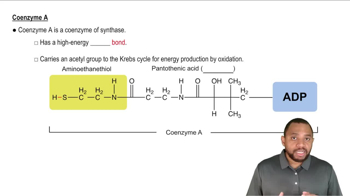
Coenzyme A Concept 4

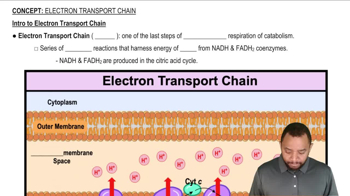
Electron Transport Chain (ETC)

The electron transport chain is a series of protein complexes and other molecules located in the inner mitochondrial membrane that facilitate the transfer of electrons derived from nutrients. As electrons move through the chain, they release energy used to pump protons across the membrane, creating a proton gradient. This gradient drives ATP synthesis through ATP synthase, making the ETC a central component of cellular respiration and energy metabolism.
Recommended video:
Guided course
3:10
Intro to Electron Transport Chain Concept 1