Pearson+ LogoPearson+ Logo
Ch.21 The Generation of Biochemical Energy
McMurry - Fundamentals of GOB 8th Edition
McMurry8th EditionFundamentals of GOBISBN: 9780134015187Not the one you use?Change textbook
Chapter 21, Problem 72

What supplies the energy to drive oxidative phosphorylation?

Verified step by step guidance
1
Oxidative phosphorylation is the process by which ATP is synthesized using energy derived from the transfer of electrons through the electron transport chain (ETC). Begin by understanding that the energy source for this process comes from the movement of electrons.
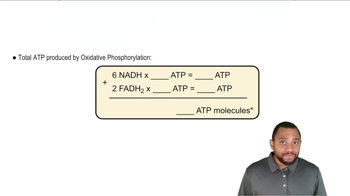
Electrons are supplied to the ETC by reduced coenzymes NADH and FADH₂, which are generated during earlier stages of cellular respiration, such as glycolysis, the citric acid cycle, and beta-oxidation of fatty acids.
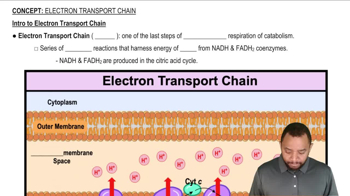
As electrons are passed along the ETC, they move through a series of protein complexes embedded in the inner mitochondrial membrane. This movement releases energy, which is used to pump protons (H⁺ ions) from the mitochondrial matrix into the intermembrane space, creating a proton gradient.
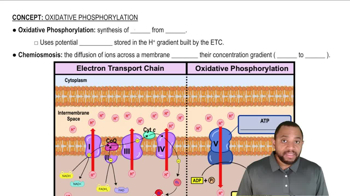
The energy stored in this proton gradient, also known as the proton-motive force, is what drives oxidative phosphorylation. Protons flow back into the mitochondrial matrix through ATP synthase, a protein complex that uses this energy to catalyze the conversion of ADP and inorganic phosphate (Pᵢ) into ATP.
In summary, the energy to drive oxidative phosphorylation is supplied by the electron transfer through the ETC, which creates a proton gradient, and the subsequent flow of protons through ATP synthase to produce ATP.

Verified video answer for a similar problem:

This video solution was recommended by our tutors as helpful for the problem above.
Video duration:
1m
Was this helpful?

Key Concepts

Here are the essential concepts you must grasp in order to answer the question correctly.

Oxidative Phosphorylation

Oxidative phosphorylation is a metabolic pathway that uses energy released by the oxidation of nutrients to produce ATP, the energy currency of the cell. This process occurs in the mitochondria and involves the electron transport chain and chemiosmosis, where electrons are transferred through a series of protein complexes, ultimately leading to the production of ATP.
Recommended video:
Guided course
0:51
Oxidative Phosphorylation Concept 2

Electron Transport Chain (ETC)

The electron transport chain is a series of protein complexes located in the inner mitochondrial membrane that facilitate the transfer of electrons from electron donors, like NADH and FADH2, to electron acceptors. This transfer releases energy, which is used to pump protons across the membrane, creating a proton gradient essential for ATP synthesis.
Recommended video:
Guided course
3:10
Intro to Electron Transport Chain Concept 1

Proton Gradient and Chemiosmosis

The proton gradient generated by the electron transport chain creates a difference in proton concentration across the inner mitochondrial membrane. This gradient drives chemiosmosis, where protons flow back into the mitochondrial matrix through ATP synthase, a process that synthesizes ATP from ADP and inorganic phosphate, effectively harnessing the energy stored in the gradient.
Recommended video:
Guided course
2:37
Oxidative Phosphorylation Concept 1