Pearson+ LogoPearson+ Logo
Ch.21 The Generation of Biochemical Energy
McMurry - Fundamentals of GOB 8th Edition
McMurry8th EditionFundamentals of GOBISBN: 9780134015187Not the one you use?Change textbook
Chapter 21, Problem 49b

FAD is a coenzyme for dehydrogenation.
b. Is FAD an oxidizing agent or a reducing agent?

Verified step by step guidance
1
Understand the role of FAD (Flavin Adenine Dinucleotide) in biochemical reactions: FAD is a coenzyme that participates in oxidation-reduction (redox) reactions, specifically in dehydrogenation reactions where it helps remove hydrogen atoms from a substrate.
Recall the definition of an oxidizing agent: An oxidizing agent is a substance that gains electrons (is reduced) during a chemical reaction, causing another substance to lose electrons (be oxidized).
Analyze the function of FAD in dehydrogenation: During dehydrogenation, FAD accepts two hydrogen atoms (including two electrons) from the substrate, converting itself into FADH₂. This means FAD is reduced in the process.
Determine whether FAD is an oxidizing or reducing agent: Since FAD gains electrons (is reduced) while causing the substrate to lose electrons (be oxidized), FAD acts as an oxidizing agent in this reaction.
Conclude: FAD is an oxidizing agent because it facilitates the oxidation of the substrate by accepting electrons and becoming reduced to FADH₂.

Verified video answer for a similar problem:

This video solution was recommended by our tutors as helpful for the problem above.
Video duration:
2m
Was this helpful?

Key Concepts

Here are the essential concepts you must grasp in order to answer the question correctly.

Coenzymes

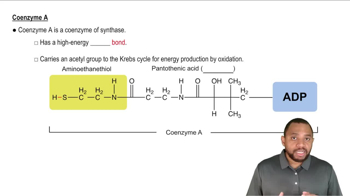
Coenzymes are organic molecules that assist enzymes in catalyzing reactions. They often act as carriers for chemical groups or electrons during metabolic processes. FAD (flavin adenine dinucleotide) is a well-known coenzyme that plays a crucial role in redox reactions, facilitating the transfer of electrons.
Recommended video:
Guided course
1:02
Coenzyme A Concept 4

Oxidizing and Reducing Agents

An oxidizing agent is a substance that gains electrons in a chemical reaction, causing another substance to be oxidized. Conversely, a reducing agent loses electrons, leading to the reduction of another substance. Understanding the roles of these agents is essential in redox reactions, where FAD can act as an oxidizing agent by accepting electrons.
Recommended video:
Guided course
1:01
Ketoses as Reducing Sugars Example 2

Dehydrogenation

Dehydrogenation is a chemical reaction that involves the removal of hydrogen from a molecule, often resulting in the formation of a double bond or a more oxidized compound. In biological systems, dehydrogenation reactions are typically coupled with the transfer of electrons to coenzymes like FAD, which then becomes reduced to FADH2.