
Pearson+ LogoPearson+ Logo
Ch.21 The Generation of Biochemical Energy
McMurry - Fundamentals of GOB 8th Edition
McMurry8th EditionFundamentals of GOBISBN: 9780134015187Not the one you use?Change textbook
Chapter 21, Problem 9

Which of the following is found in the coenzyme FAD?
a. Two heterocyclic rings
b. ADP
c. A substituted benzene ring
d. A phosphate anhydride bond

Verified step by step guidance
1
Understand the structure of FAD (Flavin Adenine Dinucleotide), which is a coenzyme involved in redox reactions. It consists of two main components: a flavin mononucleotide (FMN) and an adenosine monophosphate (AMP) group.
Analyze the components of FAD. The FMN portion contains a heterocyclic isoalloxazine ring system, while the AMP portion includes an adenine base, a ribose sugar, and a phosphate group.
Recognize that FAD contains two heterocyclic rings: the isoalloxazine ring in FMN and the adenine ring in AMP.
Note that FAD also contains ADP (adenosine diphosphate), which is formed by the combination of AMP and an additional phosphate group.
Review the other options: FAD does not contain a substituted benzene ring or a phosphate anhydride bond. Instead, it contains a phosphate ester bond connecting FMN and AMP.

Verified video answer for a similar problem:

This video solution was recommended by our tutors as helpful for the problem above.
Video duration:
1m
Was this helpful?

Key Concepts

Here are the essential concepts you must grasp in order to answer the question correctly.

Coenzymes

Coenzymes are organic molecules that assist enzymes in catalyzing biochemical reactions. They often serve as carriers for chemical groups or electrons during metabolic processes. FAD (flavin adenine dinucleotide) is a well-known coenzyme involved in redox reactions, particularly in the electron transport chain and the citric acid cycle.
Recommended video:
Guided course
1:02
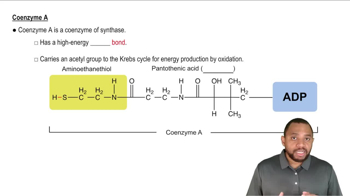
Coenzyme A Concept 4

Structure of FAD

FAD consists of a riboflavin (vitamin B2) moiety and an adenine nucleotide. The riboflavin part contains two heterocyclic rings, which are crucial for its function in electron transfer. Understanding the structural components of FAD is essential for recognizing how it interacts with enzymes and participates in metabolic pathways.
Recommended video:
Guided course
1:01
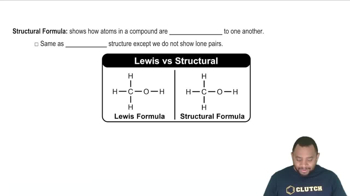
Structural Formula Concept 2

Heterocyclic Rings

Heterocyclic rings are cyclic compounds that contain atoms of at least two different elements as members of the ring. In the context of FAD, the presence of two heterocyclic rings contributes to its ability to accept and donate electrons, making it vital for various biochemical reactions. This structural feature is key to understanding the functionality of coenzymes like FAD.
Recommended video:
Guided course
2:10
Mutarotation Concept 1