
Pearson+ LogoPearson+ Logo
Ch.21 The Generation of Biochemical Energy
McMurry - Fundamentals of GOB 8th Edition
McMurry8th EditionFundamentals of GOBISBN: 9780134015187Not the one you use?Change textbook
Chapter 21, Problem 10a

Look ahead to Figure 21.8 for the citric acid cycle.
<IMAGE>
a. Draw the structures of the reactants in steps 3, 6, and 8, and indicate which hydrogen atoms are removed in these reactions.

Verified step by step guidance
1
Step 1: Review Figure 21.8 of the citric acid cycle to identify the reactants involved in steps 3, 6, and 8. These steps correspond to specific enzymatic reactions in the cycle.
Step 2: For step 3, identify the reactant (isocitrate) and the enzyme (isocitrate dehydrogenase). Draw the structure of isocitrate and indicate the hydrogen atoms removed during the oxidation and decarboxylation process, which converts isocitrate to α-ketoglutarate.
Step 3: For step 6, identify the reactant (succinate) and the enzyme (succinate dehydrogenase). Draw the structure of succinate and indicate the hydrogen atoms removed during the oxidation process, which converts succinate to fumarate. This step involves the reduction of FAD to FADH₂.
Step 4: For step 8, identify the reactant (malate) and the enzyme (malate dehydrogenase). Draw the structure of malate and indicate the hydrogen atoms removed during the oxidation process, which converts malate to oxaloacetate. This step involves the reduction of NAD⁺ to NADH.
Step 5: Ensure that the structures of the reactants are drawn accurately, and clearly mark the hydrogen atoms that are removed in each reaction. Use arrows or labels to indicate the specific bonds broken or formed during the reactions.

Verified video answer for a similar problem:

This video solution was recommended by our tutors as helpful for the problem above.
Video duration:
5m
Was this helpful?

Key Concepts

Here are the essential concepts you must grasp in order to answer the question correctly.

Citric Acid Cycle

The citric acid cycle, also known as the Krebs cycle, is a series of chemical reactions used by all aerobic organisms to generate energy. It takes place in the mitochondria and involves the oxidation of acetyl-CoA to produce ATP, NADH, and FADH2. Understanding this cycle is crucial for identifying the reactants and products involved in each step, particularly in steps 3, 6, and 8.
Recommended video:
Guided course
2:31
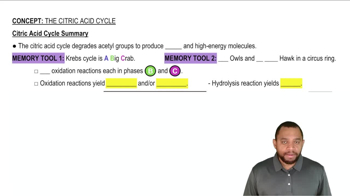
Citric Acid Cycle Summary Concept 12

Reactants and Products

In biochemical reactions, reactants are the starting materials that undergo transformation, while products are the substances formed as a result of the reaction. In the context of the citric acid cycle, recognizing the specific reactants at each step is essential for drawing their structures and understanding the flow of the cycle. Steps 3, 6, and 8 involve specific reactants that contribute to the cycle's overall function.
Recommended video:
Guided course
01:37
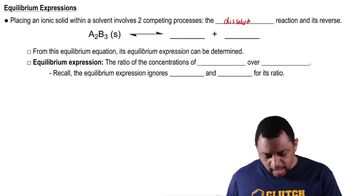
Solubility Product Constant (Ksp) Concept 2

Hydrogen Atom Removal

The removal of hydrogen atoms in biochemical reactions often signifies oxidation, where electrons are transferred from one molecule to another. In the citric acid cycle, certain steps involve dehydrogenation, where hydrogen atoms are removed from substrates, leading to the formation of NADH or FADH2. Identifying which hydrogen atoms are removed in steps 3, 6, and 8 is key to understanding the energy yield and electron transport in cellular respiration.
Recommended video:
Guided course
1:22
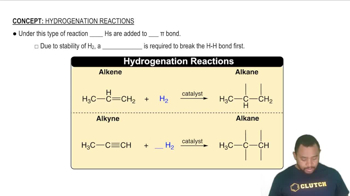
Hydrogenation Reactions Concept 1