
Pearson+ LogoPearson+ Logo
Ch.21 The Generation of Biochemical Energy
McMurry - Fundamentals of GOB 8th Edition
McMurry8th EditionFundamentals of GOBISBN: 9780134015187Not the one you use?Change textbook
Chapter 21, Problem 10b

Look ahead to Figure 21.8 for the citric acid cycle.
<IMAGE>
b. What class of enzymes carry out these reactions?

Verified step by step guidance
1
Identify the reactions in the citric acid cycle shown in Figure 21.8. The citric acid cycle involves a series of chemical reactions that convert acetyl-CoA into carbon dioxide and high-energy electron carriers.
Understand that enzymes are biological catalysts that speed up chemical reactions. Each reaction in the citric acid cycle is facilitated by a specific enzyme.
Classify the enzymes based on the type of reaction they catalyze. For example, enzymes in the citric acid cycle include oxidoreductases (which catalyze oxidation-reduction reactions), lyases (which break bonds without water), and ligases (which form bonds using ATP).
Review the specific steps of the citric acid cycle to identify the enzyme classes involved. For instance, dehydrogenases (a type of oxidoreductase) are responsible for oxidation-reduction reactions, while synthetases (a type of ligase) are involved in bond formation.
Conclude that the citric acid cycle involves multiple classes of enzymes, with oxidoreductases being particularly prominent due to the cycle's role in transferring electrons to NAD+ and FAD to form NADH and FADH2.

Verified video answer for a similar problem:

This video solution was recommended by our tutors as helpful for the problem above.
Video duration:
8m
Was this helpful?

Key Concepts

Here are the essential concepts you must grasp in order to answer the question correctly.

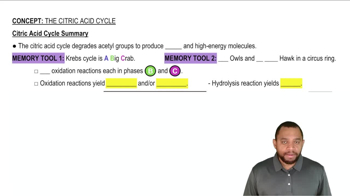
Citric Acid Cycle

The citric acid cycle, also known as the Krebs cycle, is a series of chemical reactions used by all aerobic organisms to generate energy. It takes place in the mitochondria and involves the oxidation of acetyl-CoA to produce ATP, NADH, and FADH2, which are crucial for cellular respiration. Understanding this cycle is essential for grasping how energy is produced in cells.
Recommended video:
Guided course
2:31
Citric Acid Cycle Summary Concept 12

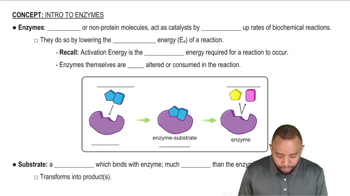
Enzymes

Enzymes are biological catalysts that speed up chemical reactions in the body without being consumed in the process. They are typically proteins that lower the activation energy required for reactions, allowing metabolic processes to occur efficiently. In the context of the citric acid cycle, specific enzymes facilitate each step of the cycle, making them vital for its function.
Recommended video:
Guided course
2:14
Intro to Enzymes Concept 1

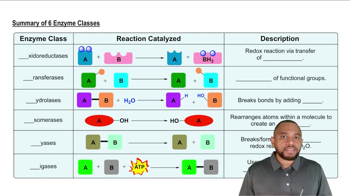
Enzyme Classes

Enzymes are categorized into six main classes based on the type of reaction they catalyze: oxidoreductases, transferases, hydrolases, lyases, isomerases, and ligases. Each class plays a distinct role in metabolic pathways, including the citric acid cycle, where oxidoreductases are particularly important for oxidation-reduction reactions. Identifying the class of enzymes involved helps in understanding their specific functions within the cycle.
Recommended video:
Guided course
3:08
Summary of 6 Enzyme Classes Concept 10