Pearson+ LogoPearson+ Logo
Ch.21 The Generation of Biochemical Energy
McMurry - Fundamentals of GOB 8th Edition
McMurry8th EditionFundamentals of GOBISBN: 9780134015187Not the one you use?Change textbook
Chapter 21, Problem 8

The hydrolysis of acetyl phosphate to give acetate and hydrogen phosphate ion has ∆G = -10.3 kcal/mol (-43.1 kJ/mol). Combine the equations and ∆G values to determine whether coupling of this reaction with phosphorylation of ADP to produce ATP is favorable. (You need give only compound names or abbreviations in the equations.)

Verified step by step guidance
1
Write the two reactions involved in the problem. The first reaction is the hydrolysis of acetyl phosphate: Acetyl phosphate → Acetate + HPO₄²⁻ (∆G = -10.3 kcal/mol). The second reaction is the phosphorylation of ADP to produce ATP: ADP + HPO₄²⁻ → ATP + H₂O (∆G = +7.3 kcal/mol).
Combine the two reactions. To do this, add the reactants and products of both reactions, canceling out any species that appear on both sides of the equation. The combined reaction will be: Acetyl phosphate + ADP → Acetate + ATP.
Add the ∆G values of the two reactions to determine the overall ∆G for the combined reaction. Use the equation: ∆G_combined = ∆G₁ + ∆G₂, where ∆G₁ is the ∆G for the hydrolysis of acetyl phosphate (-10.3 kcal/mol) and ∆G₂ is the ∆G for the phosphorylation of ADP (+7.3 kcal/mol).
Interpret the sign of the overall ∆G. If the combined ∆G is negative, the coupling of the reactions is thermodynamically favorable. If it is positive, the coupling is not favorable.
Conclude whether the coupling of the hydrolysis of acetyl phosphate with the phosphorylation of ADP to produce ATP is favorable based on the calculated overall ∆G.

Verified video answer for a similar problem:

This video solution was recommended by our tutors as helpful for the problem above.
Video duration:
5m
Was this helpful?

Key Concepts

Here are the essential concepts you must grasp in order to answer the question correctly.

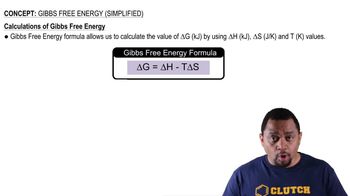
Gibbs Free Energy (∆G)

Gibbs Free Energy (∆G) is a thermodynamic potential that measures the maximum reversible work obtainable from a thermodynamic system at constant temperature and pressure. A negative ∆G indicates that a reaction is spontaneous and can occur without external energy input. In the context of biochemical reactions, it helps predict whether a reaction will proceed in the forward direction under standard conditions.
Recommended video:
Guided course
01:04
Gibbs Free Energy (Simplified) Concept 3

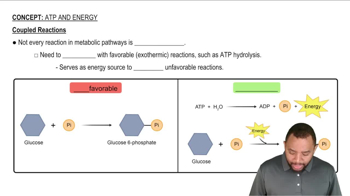
Coupled Reactions

Coupled reactions involve linking an energetically unfavorable reaction with a favorable one, allowing the overall process to proceed. In biochemistry, this often occurs when the energy released from a spontaneous reaction, such as the hydrolysis of ATP, is used to drive a non-spontaneous reaction. This principle is crucial for cellular processes, as it enables the synthesis of ATP from ADP and inorganic phosphate, despite the unfavorable nature of the phosphorylation reaction alone.
Recommended video:
Guided course
1:46
Coupled Reactions Concept 3

Phosphorylation of ADP

Phosphorylation of ADP to produce ATP is a key biochemical reaction that stores energy in the form of high-energy phosphate bonds. This process is typically coupled with exergonic reactions, such as the hydrolysis of acetyl phosphate, to make it energetically favorable. Understanding the energetics of this reaction is essential for grasping how cells manage energy transfer and storage during metabolic processes.
Recommended video:
Guided course
1:23
Oxidative Phosphorylation Example 1