
Pearson+ LogoPearson+ Logo
Ch.21 The Generation of Biochemical Energy
McMurry - Fundamentals of GOB 8th Edition
McMurry8th EditionFundamentals of GOBISBN: 9780134015187Not the one you use?Change textbook
Chapter 21, Problem 6

One of the steps in lipid metabolism is the reaction of glycerol (1,2,3-propanetriol, HOCH2CH(OH)CH2OH, with ATP to yield glycerol 1-phosphate. Write the equation for this reaction using the curved arrow symbolism.

Verified step by step guidance
1
Step 1: Understand the reaction. Glycerol (1,2,3-propanetriol) reacts with ATP (adenosine triphosphate) to form glycerol 1-phosphate and ADP (adenosine diphosphate). This is a phosphorylation reaction where a phosphate group is transferred from ATP to glycerol.
Step 2: Identify the nucleophile and electrophile. In this reaction, the hydroxyl group (-OH) on the first carbon of glycerol acts as the nucleophile, and the terminal phosphate group of ATP acts as the electrophile.
Step 3: Draw the curved arrow mechanism. Use a curved arrow to show the lone pair of electrons on the oxygen atom of the hydroxyl group attacking the phosphorus atom of the terminal phosphate group in ATP. This forms a new bond between the oxygen and phosphorus.
Step 4: Show the leaving group. As the bond between the oxygen and phosphorus forms, the bond between the terminal phosphate group and the rest of the ATP molecule breaks, resulting in the release of ADP as the leaving group.
Step 5: Write the balanced chemical equation. The reaction can be represented as: HOCH2(OH)CH(OH)+ATPHOCH2(OPOCH(OH)+ADP. Ensure the curved arrows and electron flow are clearly depicted in your diagram.

Verified video answer for a similar problem:

This video solution was recommended by our tutors as helpful for the problem above.
Video duration:
3m
Was this helpful?

Key Concepts

Here are the essential concepts you must grasp in order to answer the question correctly.

Lipid Metabolism

Lipid metabolism refers to the biochemical processes involved in the synthesis and degradation of lipids in cells. It includes the breakdown of fats for energy and the synthesis of fatty acids and glycerol. Understanding lipid metabolism is crucial for grasping how glycerol is utilized in energy production and how it interacts with other metabolic pathways.
Recommended video:
Guided course
5:50
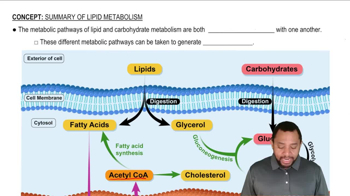
Summary of Lipid Metabolism Concept 1

Curved Arrow Symbolism

Curved arrow symbolism is a method used in organic chemistry to depict the movement of electrons during chemical reactions. The arrows indicate the direction of electron flow, helping to visualize the formation and breaking of bonds. This notation is essential for accurately representing the reaction of glycerol with ATP, as it illustrates how energy is transferred and chemical bonds are formed.
Recommended video:
Guided course
05:54
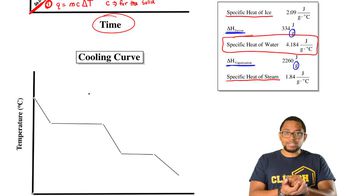
Heating and Cooling Curves Concept 2

ATP (Adenosine Triphosphate)

ATP, or adenosine triphosphate, is the primary energy carrier in all living organisms. It provides the energy required for various biochemical reactions, including those in lipid metabolism. In the context of the reaction with glycerol, ATP donates a phosphate group, facilitating the conversion of glycerol to glycerol 1-phosphate, which is a key intermediate in lipid synthesis.
Recommended video:
Guided course
1:03
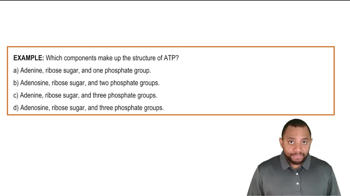
Adenosine Triphosphate (ATP) Example 2
Related Practice
Textbook Question

The overall equation in this section,

shows the cycle between photosynthesis and oxidation. Pathways operating in opposite directions cannot be exergonic in both directions.

a. Which of the two pathways in this cycle is exergonic and which is endergonic?

928
views
Textbook Question

Acetyl phosphate, whose structure is given here, is another compound with a relatively high free energy of hydrolysis.

Using structural formulas, write the equation for the hydrolysis of this phosphate.

862
views
Textbook Question

A common metabolic strategy is the lack of reactivity—that is, the slowness to react—of compounds whose breakdown is exergonic. For example, hydrolysis of ATP to ADP or adenosine monophosphate (AMP) is exergonic but does not take place without an appropriate enzyme present. Why would the cell use this metabolic strategy?

929
views
Textbook Question

The hydrolysis of acetyl phosphate to give acetate and hydrogen phosphate ion has ∆G = -10.3 kcal/mol (-43.1 kJ/mol). Combine the equations and ∆G values to determine whether coupling of this reaction with phosphorylation of ADP to produce ATP is favorable. (You need give only compound names or abbreviations in the equations.)

900
views
Textbook Question

Which of the following is found in the coenzyme FAD?

a. Two heterocyclic rings

b. ADP

c. A substituted benzene ring

d. A phosphate anhydride bond

713
views
Textbook Question

Look ahead to Figure 21.8 for the citric acid cycle.

<IMAGE>

a. Draw the structures of the reactants in steps 3, 6, and 8, and indicate which hydrogen atoms are removed in these reactions.

698
views