Pearson+ LogoPearson+ Logo
Ch.21 The Generation of Biochemical Energy
McMurry - Fundamentals of GOB 8th Edition
McMurry8th EditionFundamentals of GOBISBN: 9780134015187Not the one you use?Change textbook
Chapter 21, Problem 57

Which reactions of the citric acid cycle transfer energy as FADH2?

Verified step by step guidance
1
Identify the role of FADH2 in the citric acid cycle: FADH2 is a high-energy electron carrier that is produced during specific oxidation reactions in the cycle. It transfers electrons to the electron transport chain, contributing to ATP production.
Recall the specific reaction in the citric acid cycle where FADH2 is generated: This occurs during the oxidation of succinate to fumarate, catalyzed by the enzyme succinate dehydrogenase.
Understand the chemical process: In this reaction, succinate loses two hydrogen atoms (oxidation), and FAD (flavin adenine dinucleotide) is reduced to FADH2 by accepting these hydrogen atoms.
Write the balanced chemical equation for the reaction: Succinate + FAD → Fumarate + FADH2. This shows the conversion of succinate to fumarate and the simultaneous reduction of FAD to FADH2.
Recognize the significance of this step: The FADH2 produced in this reaction will later donate its electrons to the electron transport chain, specifically at Complex II, contributing to the generation of ATP through oxidative phosphorylation.

Verified video answer for a similar problem:

This video solution was recommended by our tutors as helpful for the problem above.
Video duration:
2m
Was this helpful?

Key Concepts

Here are the essential concepts you must grasp in order to answer the question correctly.

Citric Acid Cycle

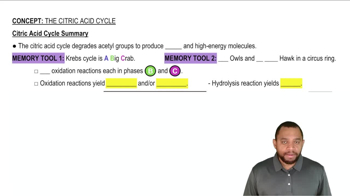
The citric acid cycle, also known as the Krebs cycle, is a series of enzymatic reactions that occur in the mitochondria. It plays a crucial role in cellular respiration by oxidizing acetyl-CoA to produce energy carriers, including NADH and FADH2, which are essential for ATP production in the electron transport chain.
Recommended video:
Guided course
2:31
Citric Acid Cycle Summary Concept 12

FADH2 Production

FADH2 is a reduced form of flavin adenine dinucleotide (FAD) and serves as an important electron carrier in the citric acid cycle. It is produced during specific reactions, such as the conversion of succinate to fumarate, where FAD is reduced to FADH2, capturing energy that can later be used to generate ATP.
Recommended video:
Guided course
01:37
Solubility Product Constant (Ksp) Concept 2

Energy Transfer in Metabolism

Energy transfer in metabolism refers to the process by which energy stored in nutrients is converted into usable forms, primarily ATP. In the context of the citric acid cycle, the transfer of electrons from FADH2 to the electron transport chain is a key step in this process, ultimately leading to the production of ATP through oxidative phosphorylation.
Recommended video:
Guided course
1:14
Glycerol Metabolism Concept 3