Pearson+ LogoPearson+ Logo
Ch.21 The Generation of Biochemical Energy
McMurry - Fundamentals of GOB 8th Edition
McMurry8th EditionFundamentals of GOBISBN: 9780134015187Not the one you use?Change textbook
Chapter 21, Problem 61

What two coenzymes are involved with initial events of the electron-transport chain?

Verified step by step guidance
1
Understand that the electron-transport chain (ETC) is a series of protein complexes and coenzymes located in the inner mitochondrial membrane, responsible for transferring electrons and generating a proton gradient to produce ATP.
Recall that the initial events of the ETC involve the transfer of electrons from reduced coenzymes to the first protein complex in the chain.
Identify the two key coenzymes involved in these initial events: NADH (Nicotinamide Adenine Dinucleotide, reduced form) and FADH₂ (Flavin Adenine Dinucleotide, reduced form). These coenzymes are produced during earlier metabolic processes like glycolysis, the citric acid cycle, and beta-oxidation.
Recognize that NADH donates its electrons to Complex I (NADH dehydrogenase), while FADH₂ donates its electrons to Complex II (succinate dehydrogenase). These complexes then pass the electrons further down the chain.
Understand that the transfer of electrons from NADH and FADH₂ to the ETC is a critical step in cellular respiration, as it initiates the process of oxidative phosphorylation, ultimately leading to ATP production.

Verified video answer for a similar problem:

This video solution was recommended by our tutors as helpful for the problem above.
Video duration:
54s
Was this helpful?

Key Concepts

Here are the essential concepts you must grasp in order to answer the question correctly.

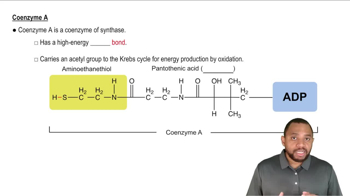
Coenzymes

Coenzymes are organic molecules that assist enzymes in catalyzing reactions. They often serve as carriers for chemical groups or electrons during metabolic processes. In the context of the electron transport chain, coenzymes play a crucial role in transferring electrons, which is essential for ATP production.
Recommended video:
Guided course
1:02
Coenzyme A Concept 4

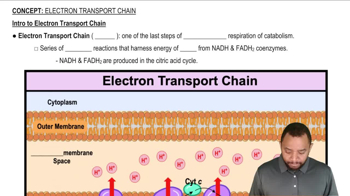
Electron Transport Chain (ETC)

The electron transport chain is a series of protein complexes located in the inner mitochondrial membrane that facilitate the transfer of electrons derived from nutrients. This process generates a proton gradient that drives ATP synthesis. Understanding the ETC is vital for grasping how cells convert energy from food into usable forms.
Recommended video:
Guided course
3:10
Intro to Electron Transport Chain Concept 1

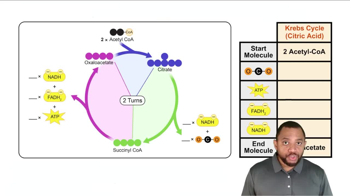
NADH and FADH2

NADH and FADH2 are two key coenzymes that donate electrons to the electron transport chain. NADH is produced during glycolysis and the Krebs cycle, while FADH2 is generated in the Krebs cycle. These coenzymes are essential for initiating the electron transport process, ultimately leading to ATP production through oxidative phosphorylation.
Recommended video:
Guided course
2:27
Citric Acid Cycle Summary Concept 13