Pearson+ LogoPearson+ Logo
Ch.22 Carbohydrate Metabolism
McMurry - Fundamentals of GOB 8th Edition
McMurry8th EditionFundamentals of GOBISBN: 9780134015187Not the one you use?Change textbook
Chapter 22, Problem 62

Name the two molecules that serve as starting materials for glucose synthesis.

Verified step by step guidance
1
Understand that glucose synthesis refers to the process of gluconeogenesis, which is the metabolic pathway that generates glucose from non-carbohydrate precursors.
Recall that the two primary starting materials for glucose synthesis are pyruvate and glycerol. These molecules are converted into intermediates that feed into the gluconeogenesis pathway.
Pyruvate is derived from the breakdown of carbohydrates (via glycolysis) or from amino acids through deamination. It serves as a key starting material in the gluconeogenesis pathway.
Glycerol is obtained from the breakdown of triglycerides (fats) and enters gluconeogenesis after being converted into dihydroxyacetone phosphate (DHAP), an intermediate in the pathway.
Summarize that the two molecules, pyruvate and glycerol, are critical starting materials for the synthesis of glucose in the gluconeogenesis process.

Verified video answer for a similar problem:

This video solution was recommended by our tutors as helpful for the problem above.
Video duration:
1m
Was this helpful?

Key Concepts

Here are the essential concepts you must grasp in order to answer the question correctly.

Photosynthesis

Photosynthesis is the biological process by which green plants, algae, and some bacteria convert light energy into chemical energy, specifically glucose. This process primarily occurs in the chloroplasts of plant cells and involves the absorption of sunlight, carbon dioxide, and water to produce glucose and oxygen. Understanding photosynthesis is crucial for identifying the starting materials for glucose synthesis.

Carbon Dioxide (CO2)

Carbon dioxide is a colorless, odorless gas that is a key reactant in the process of photosynthesis. Plants absorb CO2 from the atmosphere through small openings called stomata. This carbon source is essential for the synthesis of glucose, as it provides the carbon atoms that are incorporated into the glucose molecule.
Recommended video:
Guided course
5:36
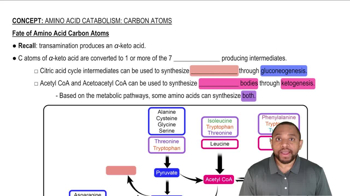
Amino Acid Catabolism: Carbon Atoms Concept 2

Water (H2O)

Water is another vital starting material for glucose synthesis during photosynthesis. It is absorbed by plant roots and transported to the leaves, where it is split into oxygen and hydrogen during the light-dependent reactions. The hydrogen is then used in the Calvin cycle to help convert carbon dioxide into glucose, making water an essential component of this process.
Recommended video:
Guided course
01:30
Conjugate Acid-Base Pairs