Name the two molecules that serve as starting materials for glucose synthesis.
Ch.22 Carbohydrate Metabolism
Chapter 22, Problem 73a
How many moles of ATP are generated from the catabolism of fructose (by glycolysis) in
(a) liver cells?
Verified step by step guidance1
Understand the context: Glycolysis is the metabolic pathway that breaks down glucose or fructose into pyruvate, generating ATP in the process. In liver cells, fructose enters glycolysis after being converted into intermediates of the pathway.
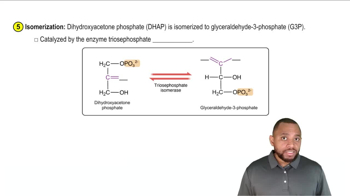
Determine the entry point of fructose in glycolysis: In liver cells, fructose is phosphorylated by fructokinase to form fructose-1-phosphate. This is then cleaved into dihydroxyacetone phosphate (DHAP) and glyceraldehyde by aldolase B. Glyceraldehyde is further phosphorylated to glyceraldehyde-3-phosphate (G3P). Both DHAP and G3P are intermediates in glycolysis.
Recall the ATP yield from glycolysis: Each molecule of glucose (or equivalent intermediates like fructose-derived G3P and DHAP) generates a net gain of 2 ATP molecules per molecule of fructose processed through glycolysis. This accounts for the ATP consumed during the preparatory phase and the ATP produced during the payoff phase.
Set up the calculation: Since one molecule of fructose is metabolized into two molecules of G3P (or equivalent intermediates), and each G3P generates 2 ATP during glycolysis, calculate the total ATP yield by multiplying the number of G3P molecules by the ATP yield per G3P.
Conclude the calculation: Use the stoichiometry of the glycolysis pathway to determine the total moles of ATP generated per mole of fructose catabolized in liver cells. Ensure to account for the net ATP yield after subtracting the ATP consumed in the initial steps of fructose metabolism.

Verified video answer for a similar problem:
This video solution was recommended by our tutors as helpful for the problem above.
Video duration:
2mWas this helpful?
Key Concepts
Here are the essential concepts you must grasp in order to answer the question correctly.
Glycolysis
Glycolysis is a metabolic pathway that converts glucose or other carbohydrates, such as fructose, into pyruvate, producing a net gain of ATP and NADH. This process occurs in the cytoplasm of cells and consists of ten enzymatic reactions. In the case of fructose, it is phosphorylated and then enters the glycolytic pathway, ultimately leading to ATP production.
Recommended video:
Guided course
Glycolysis Concept 5
ATP Yield from Fructose
The catabolism of fructose through glycolysis yields a different amount of ATP compared to glucose. Fructose is converted into intermediates that can enter glycolysis, resulting in a net production of 2 ATP molecules per molecule of fructose. This is because fructose bypasses the initial phosphorylation step that glucose undergoes, leading to a more direct pathway to ATP generation.
Recommended video:
Guided course
Percent Yield
Liver Metabolism
Liver cells have unique metabolic pathways that allow them to process fructose efficiently. Unlike muscle cells, liver cells can convert fructose into glucose or directly into intermediates for glycolysis. This metabolic flexibility is crucial for maintaining blood sugar levels and energy homeostasis, influencing the overall ATP yield from fructose catabolism in the liver.
Recommended video:
Guided course
Glycerol Metabolism Concept 2
Related Practice
Textbook Question
819
views
Textbook Question
How many steps in gluconeogenesis are not the exact reversal of the steps in glycolysis? What kind of conversion of substrate to product does each involve? What is the common theme in each of these reactions?
724
views
Textbook Question
Explain why the Cori cycle is necessary and when your cells would use this cycle.
681
views
Textbook Question
How many moles of ATP are generated from the catabolism of fructose (by glycolysis) in
(b) muscle cells?
745
views

Textbook Question
Which of the following conversions would you expect to consume energy and which would you expect to yield energy based on the final oxidation state of the coenzymes involved in each reaction?
a. pyruvate → lactate
626
views
Textbook Question
Why is it important for muscle cells to export lactate into the bloodstream during heavy exercise?
703
views