Pearson+ LogoPearson+ Logo
Ch.22 Carbohydrate Metabolism
McMurry - Fundamentals of GOB 8th Edition
McMurry8th EditionFundamentals of GOBISBN: 9780134015187Not the one you use?Change textbook
Chapter 22, Problem 25c

Outline the conditions that direct pyruvate toward the following:
c. Conversion to lactate
In what tissues or organisms is each pathway present?

Verified step by step guidance
1
Understand the context: Pyruvate is a key intermediate in cellular metabolism, and its fate depends on the availability of oxygen and the energy needs of the cell. Conversion to lactate occurs under anaerobic conditions (low oxygen levels).
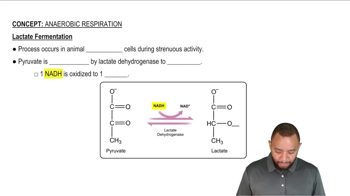
Explain the biochemical pathway: Under anaerobic conditions, pyruvate is reduced to lactate by the enzyme lactate dehydrogenase. This process regenerates NAD⁺ from NADH, which is essential for glycolysis to continue producing ATP in the absence of oxygen.
Identify the conditions: The conversion of pyruvate to lactate typically occurs in tissues or organisms experiencing low oxygen availability, such as during intense exercise in human muscle cells or in certain microorganisms like lactic acid bacteria.
Discuss the role of lactate: In human muscle cells, lactate can accumulate during strenuous activity, leading to temporary muscle fatigue. However, lactate can later be transported to the liver, where it is converted back to glucose via the Cori cycle.
Summarize the tissues and organisms: The conversion of pyruvate to lactate is prominent in human muscle cells under anaerobic conditions and in microorganisms like lactic acid bacteria, which use this pathway for energy production in oxygen-deprived environments.

Verified video answer for a similar problem:

This video solution was recommended by our tutors as helpful for the problem above.
Video duration:
3m
Was this helpful?

Key Concepts

Here are the essential concepts you must grasp in order to answer the question correctly.

Pyruvate Metabolism

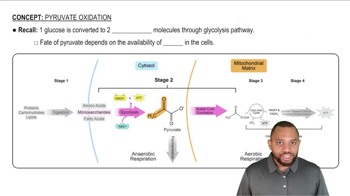
Pyruvate is a key intermediate in cellular metabolism, primarily produced from glycolysis. Its fate depends on the cellular environment, including oxygen availability. Under aerobic conditions, pyruvate enters the mitochondria for further oxidation, while under anaerobic conditions, it can be converted to lactate in a process called lactic acid fermentation.
Recommended video:
Guided course
1:49
Pyruvate Oxidation Concept 1

Lactate Fermentation

Lactate fermentation is an anaerobic process where pyruvate is reduced to lactate by the enzyme lactate dehydrogenase. This process regenerates NAD+, allowing glycolysis to continue producing ATP in the absence of oxygen. It is particularly important in muscle cells during intense exercise and in certain microorganisms, such as lactic acid bacteria.
Recommended video:
Guided course
1:14
Anaerobic Respiration Concept 3

Tissue and Organism Specificity

Different tissues and organisms utilize pyruvate differently based on their metabolic needs and oxygen availability. For instance, human muscle cells convert pyruvate to lactate during strenuous activity, while liver cells primarily convert it to glucose via gluconeogenesis. In contrast, some anaerobic bacteria rely exclusively on lactate fermentation for energy production.
Recommended video:
Guided course
01:37
Specific Gravity