Pearson+ LogoPearson+ Logo
Ch.22 Carbohydrate Metabolism
McMurry - Fundamentals of GOB 8th Edition
McMurry8th EditionFundamentals of GOBISBN: 9780134015187Not the one you use?Change textbook
Chapter 22, Problem 45a

Which glycolysis reactions are catalyzed by the following enzymes?
a. Pyruvate kinase

Verified step by step guidance
1
Identify the role of pyruvate kinase in glycolysis. Pyruvate kinase catalyzes the final step of glycolysis, where phosphoenolpyruvate (PEP) is converted into pyruvate.
Understand the reaction catalyzed by pyruvate kinase. This reaction involves the transfer of a phosphate group from PEP to ADP, forming ATP and pyruvate. This is an example of substrate-level phosphorylation.
Write the chemical equation for the reaction: PEP+ADPPyruvate+ATP
Recognize the importance of this step. It is an irreversible reaction in glycolysis and is highly regulated to ensure proper energy production in the cell.
Note that this reaction is part of the energy payoff phase of glycolysis, where ATP is generated, contributing to the net gain of ATP in the process.

Verified video answer for a similar problem:

This video solution was recommended by our tutors as helpful for the problem above.
Video duration:
4m
Was this helpful?

Key Concepts

Here are the essential concepts you must grasp in order to answer the question correctly.

Glycolysis

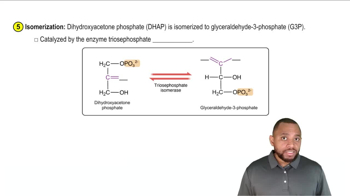
Glycolysis is a metabolic pathway that converts glucose into pyruvate, producing energy in the form of ATP and NADH. It consists of ten enzyme-catalyzed reactions and occurs in the cytoplasm of cells. Understanding glycolysis is essential for grasping how cells generate energy and the role of various enzymes in this process.
Recommended video:
Guided course
1:26
Glycolysis Concept 5

Enzyme Catalysis

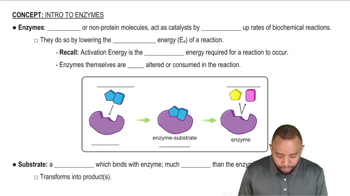
Enzyme catalysis refers to the process by which enzymes accelerate chemical reactions in biological systems. Each enzyme is specific to a particular reaction or type of reaction, lowering the activation energy required and increasing the reaction rate. In glycolysis, enzymes like pyruvate kinase play crucial roles in facilitating specific steps of the pathway.
Recommended video:
Guided course
2:14
Intro to Enzymes Concept 1

Pyruvate Kinase

Pyruvate kinase is an enzyme that catalyzes the final step of glycolysis, converting phosphoenolpyruvate (PEP) into pyruvate while producing ATP. This reaction is a key regulatory point in glycolysis and is influenced by various factors, including the availability of substrates and allosteric regulators. Understanding its function helps in comprehending the overall regulation of energy production in cells.
Recommended video:
Guided course
1:38
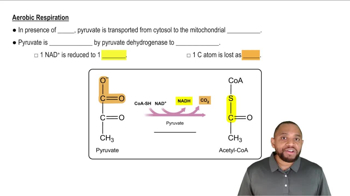
Pyruvate Oxidation Concept 2