Pearson+ LogoPearson+ Logo
Ch.22 Carbohydrate Metabolism
McMurry - Fundamentals of GOB 8th Edition
McMurry8th EditionFundamentals of GOBISBN: 9780134015187Not the one you use?Change textbook
Chapter 22, Problem 47a

How many moles of ATP are produced by phosphorylation in the following?
a. Glycolysis of 1 mol of glucose

Verified step by step guidance
1
Understand the process of glycolysis: Glycolysis is the metabolic pathway that breaks down 1 molecule of glucose (C₆H₁₂O₆) into 2 molecules of pyruvate. During this process, ATP is both consumed and produced.
Identify the net ATP production in glycolysis: Glycolysis consumes 2 ATP molecules in its initial steps (energy investment phase) and produces 4 ATP molecules in its later steps (energy payoff phase). The net production of ATP is therefore 4 - 2 = 2 ATP molecules per glucose molecule.
Relate ATP production to moles: Since the problem specifies 1 mole of glucose, the net ATP production will be directly proportional. For every 1 mole of glucose, 2 moles of ATP are produced.
Express the relationship mathematically: The net ATP production can be written as: \( \text{Net ATP} = 2 \times \text{moles of glucose} \). Substituting 1 mole of glucose, \( \text{Net ATP} = 2 \times 1 = 2 \text{ moles of ATP} \).
Conclude the calculation: The glycolysis of 1 mole of glucose results in the production of 2 moles of ATP through phosphorylation.

Verified video answer for a similar problem:

This video solution was recommended by our tutors as helpful for the problem above.
Video duration:
1m
Was this helpful?

Key Concepts

Here are the essential concepts you must grasp in order to answer the question correctly.

Glycolysis

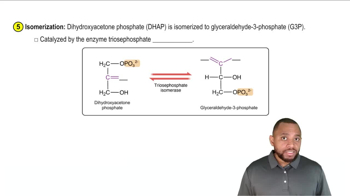
Glycolysis is a metabolic pathway that converts glucose into pyruvate, producing energy in the form of ATP. This process occurs in the cytoplasm and involves a series of enzymatic reactions. For each molecule of glucose, glycolysis typically yields a net gain of 2 ATP molecules through substrate-level phosphorylation.
Recommended video:
Guided course
1:26
Glycolysis Concept 5

ATP Production

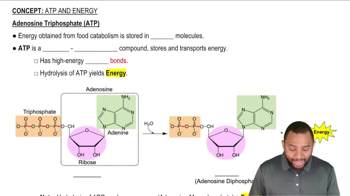
Adenosine triphosphate (ATP) is the primary energy carrier in cells. During glycolysis, ATP is produced through substrate-level phosphorylation, where a phosphate group is directly transferred to ADP from a phosphorylated intermediate. Understanding the ATP yield from glycolysis is crucial for evaluating the energy efficiency of cellular respiration.
Recommended video:
Guided course
2:20
Adenosine Triphosphate (ATP) Concept 2

Phosphorylation

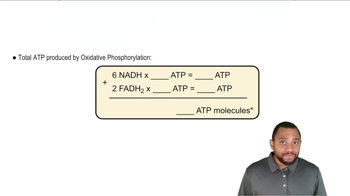
Phosphorylation is the process of adding a phosphate group to a molecule, often to activate or deactivate enzymes and other proteins. In the context of glycolysis, phosphorylation refers to the addition of phosphate groups to glucose and intermediates, which is essential for the energy investment phase and ultimately leads to ATP production.
Recommended video:
Guided course
0:51
Oxidative Phosphorylation Concept 2