Pearson+ LogoPearson+ Logo
Ch.22 Carbohydrate Metabolism
McMurry - Fundamentals of GOB 8th Edition
McMurry8th EditionFundamentals of GOBISBN: 9780134015187Not the one you use?Change textbook
Chapter 22, Problem 74a

Which of the following conversions would you expect to consume energy and which would you expect to yield energy based on the final oxidation state of the coenzymes involved in each reaction?
a. pyruvate → lactate

Verified step by step guidance
1
Identify the chemical reaction: The conversion of pyruvate to lactate involves the reduction of pyruvate to lactate. This reaction is catalyzed by the enzyme lactate dehydrogenase.
Understand the role of coenzymes: In this reaction, the coenzyme NADH is oxidized to NAD⁺ as it donates electrons to pyruvate, reducing it to lactate.
Determine energy consumption or release: Reduction reactions (such as pyruvate → lactate) typically consume energy because they involve the gain of electrons by a molecule. The energy comes from the oxidation of NADH to NAD⁺.
Analyze the oxidation state changes: Pyruvate is reduced (its oxidation state decreases), while NADH is oxidized (its oxidation state increases). This indicates that energy is consumed in the process.
Conclude the energy flow: Since the reaction involves the reduction of pyruvate and the oxidation of NADH, it is expected to consume energy rather than yield energy.

Verified video answer for a similar problem:

This video solution was recommended by our tutors as helpful for the problem above.
Video duration:
2m
Was this helpful?

Key Concepts

Here are the essential concepts you must grasp in order to answer the question correctly.

Oxidation-Reduction Reactions

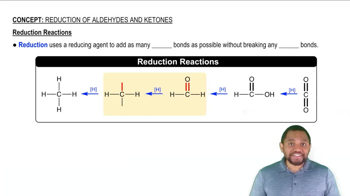
Oxidation-reduction (redox) reactions involve the transfer of electrons between molecules, leading to changes in their oxidation states. In biological systems, these reactions are crucial for energy production and consumption. Understanding which molecules are oxidized and reduced helps predict whether a reaction will consume or yield energy.
Recommended video:
Guided course
2:38
Reduction Reactions Concept 1

Coenzymes in Metabolism

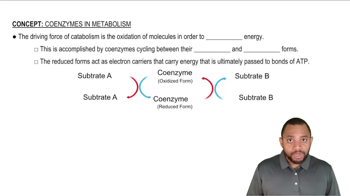
Coenzymes are organic molecules that assist enzymes in catalyzing biochemical reactions. They often act as electron carriers, playing a vital role in metabolic pathways. The final oxidation state of coenzymes, such as NADH or NAD+, indicates whether a reaction is likely to release energy (when reduced) or require energy (when oxidized).
Recommended video:
Guided course
2:02
Coenzymes in Metabolism Concept 1

Lactic Acid Fermentation

Lactic acid fermentation is an anaerobic process where pyruvate is converted to lactate, typically in muscle cells during intense exercise. This conversion regenerates NAD+, allowing glycolysis to continue producing ATP. It is important to note that this process consumes energy in the form of NADH, which is oxidized back to NAD+.
Recommended video: