Pearson+ LogoPearson+ Logo
Ch.23 Lipids
McMurry - Fundamentals of GOB 8th Edition
McMurry8th EditionFundamentals of GOBISBN: 9780134015187Not the one you use?Change textbook
Chapter 23, Problem 76

Which of the following are saponifiable lipids? (Recall that ester bonds are broken by base hydrolysis.)
a. Progesterone
b. Glyceryl trioleate
c. A sphingomyelin
d. Prostaglandin E1
e. A cerebroside
f. A lecithin

Verified step by step guidance
1
Step 1: Understand the term 'saponifiable lipids.' Saponifiable lipids are lipids that contain ester bonds, which can be hydrolyzed (broken) in the presence of a base. Examples include triglycerides, phospholipids, and glycolipids.
Step 2: Analyze each option to determine if it contains ester bonds. For example, glyceryl trioleate is a triglyceride, which contains ester bonds, making it saponifiable.
Step 3: Recall the structure of sphingomyelin and lecithin. Sphingomyelin is a phospholipid, and lecithin is also a phospholipid. Both contain ester bonds and are therefore saponifiable.
Step 4: Examine the structures of progesterone, prostaglandin E1, and cerebrosides. Progesterone and prostaglandin E1 are not saponifiable because they do not contain ester bonds. Cerebrosides, however, are glycolipids and contain ester bonds, making them saponifiable.
Step 5: Summarize the findings. The saponifiable lipids in the list are glyceryl trioleate, sphingomyelin, cerebroside, and lecithin. Progesterone and prostaglandin E1 are not saponifiable.

Verified video answer for a similar problem:

This video solution was recommended by our tutors as helpful for the problem above.
Video duration:
3m
Was this helpful?

Key Concepts

Here are the essential concepts you must grasp in order to answer the question correctly.

Saponifiable Lipids

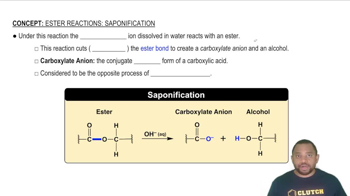
Saponifiable lipids are fats and oils that can be hydrolyzed into their constituent fatty acids and glycerol through a process called saponification. This process typically involves the reaction of lipids with a strong base, which breaks the ester bonds present in triglycerides and phospholipids. Examples include triglycerides and phospholipids, which are essential for biological membranes.
Recommended video:
Guided course
1:25
Ester Reactions: Saponification Concept 1

Ester Bonds

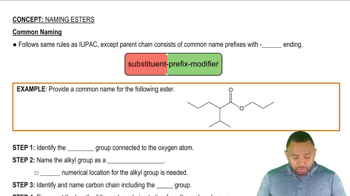
Ester bonds are chemical linkages formed between an alcohol and a carboxylic acid, resulting in the formation of esters. In lipids, these bonds connect fatty acids to glycerol or sphingosine backbones. The hydrolysis of ester bonds is a key reaction in the breakdown of saponifiable lipids, allowing for the release of fatty acids and other components.
Recommended video:
Guided course
3:30
Common Naming: Esters Concept 2

Types of Lipids

Lipids can be categorized into saponifiable and non-saponifiable types. Saponifiable lipids, such as triglycerides and phospholipids, can be hydrolyzed into smaller molecules, while non-saponifiable lipids, like steroids and certain vitamins, do not contain ester bonds and cannot undergo saponification. Understanding these categories is crucial for identifying which lipids can be saponified.
Recommended video:
Guided course
1:09
Intro to Lipids Concept 2