Pearson+ LogoPearson+ Logo
Ch.23 Lipids
McMurry - Fundamentals of GOB 8th Edition
McMurry8th EditionFundamentals of GOBISBN: 9780134015187Not the one you use?Change textbook
Chapter 23, Problem 77

Identify the component parts of each saponifiable lipid listed in Problem 23.76.
a. Progesterone
b. Glyceryl trioleate
c. A sphingomyelin
d. Prostaglandin
e. A cerebroside
f. A lecithin

Verified step by step guidance
1
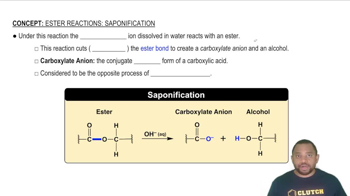
Understand the term 'saponifiable lipid': Saponifiable lipids are lipids that can be hydrolyzed in the presence of a strong base (like NaOH or KOH) to produce glycerol and fatty acid salts (soaps). Examples include triglycerides, phospholipids, and waxes.
Review the structure of the lipid in question: For each lipid listed in Problem 23.76, identify whether it is a triglyceride, phospholipid, or wax. This will help determine its component parts.
Break down the structure of the lipid: For triglycerides, identify the glycerol backbone and the three fatty acid chains. For phospholipids, identify the glycerol backbone, two fatty acid chains, and the phosphate group with its attached molecule. For waxes, identify the long-chain alcohol and the fatty acid.
Write the hydrolysis reaction: Represent the saponification reaction for each lipid. For example, for a triglyceride, the reaction would involve the lipid reacting with NaOH to produce glycerol and three fatty acid salts.
Summarize the component parts: After hydrolysis, list the products for each lipid. For triglycerides, the products are glycerol and fatty acid salts. For phospholipids, the products are glycerol, fatty acid salts, and a phosphate-containing group. For waxes, the products are a long-chain alcohol and a fatty acid salt.

Verified video answer for a similar problem:

This video solution was recommended by our tutors as helpful for the problem above.
Video duration:
4m
Was this helpful?

Key Concepts

Here are the essential concepts you must grasp in order to answer the question correctly.

Saponifiable Lipids

Saponifiable lipids are a category of lipids that can be hydrolyzed into their constituent fatty acids and glycerol through a process called saponification. This process typically involves the reaction of lipids with an alkali, resulting in the formation of soap and glycerin. Common examples include triglycerides and phospholipids, which are essential for various biological functions.
Recommended video:
Guided course
1:25
Ester Reactions: Saponification Concept 1

Fatty Acids

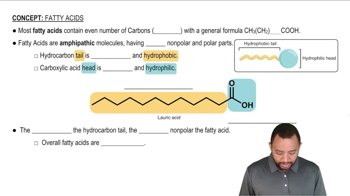
Fatty acids are carboxylic acids with long hydrocarbon chains, which can be saturated (no double bonds) or unsaturated (one or more double bonds). They are the building blocks of saponifiable lipids and play a crucial role in energy storage, cellular structure, and signaling. Understanding the types and structures of fatty acids is essential for analyzing the properties of lipids.
Recommended video:
Guided course
2:00
Fatty Acids Concept 1

Glycerol

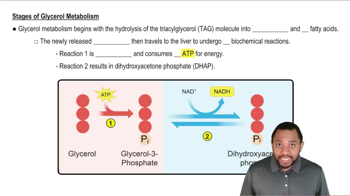
Glycerol is a three-carbon alcohol that serves as the backbone for triglycerides and phospholipids. Each of the three hydroxyl (-OH) groups in glycerol can form an ester bond with fatty acids, resulting in the formation of saponifiable lipids. Glycerol is also important in metabolism and can be converted into glucose or used in the synthesis of other biomolecules.
Recommended video:
Guided course
1:20
Glycerol Metabolism Concept 2