Pearson+ LogoPearson+ Logo
Ch.23 Lipids
McMurry - Fundamentals of GOB 8th Edition
McMurry8th EditionFundamentals of GOBISBN: 9780134015187Not the one you use?Change textbook
Chapter 23, Problem 78

Draw the structure of a triacylglycerol made from two molecules of myristic acid and one molecule of linolenic acid.

Verified step by step guidance
1
Understand the structure of a triacylglycerol: A triacylglycerol (TAG) is composed of a glycerol backbone (a three-carbon molecule with hydroxyl groups on each carbon) esterified with three fatty acid molecules. Each fatty acid is attached to one of the hydroxyl groups of glycerol via an ester bond.
Identify the fatty acids involved: Myristic acid is a saturated fatty acid with the formula CH₃(CH₂)₁₂COOH, and linolenic acid is an unsaturated fatty acid with the formula CH₃CH₂(CH=CHCH₂)₃(CH₂)₆COOH. Note that linolenic acid contains three double bonds, making it polyunsaturated.
Assign the fatty acids to the glycerol backbone: Attach two molecules of myristic acid to two of the hydroxyl groups on the glycerol backbone and one molecule of linolenic acid to the remaining hydroxyl group. The order of attachment does not affect the chemical identity of the triacylglycerol.
Form ester bonds: Replace the hydroxyl group (-OH) of each fatty acid with an ester linkage (-COO-) by reacting the carboxylic acid group (-COOH) of the fatty acid with the hydroxyl group (-OH) of glycerol. This reaction releases water (H₂O) as a byproduct.
Draw the complete structure: Represent the glycerol backbone with its three carbons, each connected to an ester bond. Attach the hydrocarbon chains of the two myristic acid molecules and the linolenic acid molecule to the respective ester bonds. Ensure the double bonds in linolenic acid are correctly placed in the structure.

Verified video answer for a similar problem:

This video solution was recommended by our tutors as helpful for the problem above.
Video duration:
7m
Was this helpful?

Key Concepts

Here are the essential concepts you must grasp in order to answer the question correctly.

Triacylglycerol Structure

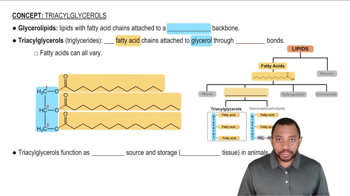
Triacylglycerols, also known as triglycerides, are lipids composed of three fatty acid molecules esterified to a glycerol backbone. The structure is characterized by the presence of a glycerol molecule, which has three hydroxyl (-OH) groups, each linked to a fatty acid via an ester bond. This configuration allows for the storage of energy in adipose tissue and plays a crucial role in metabolism.
Recommended video:
Guided course
1:52
Triacylglycerols Concept 1

Fatty Acids

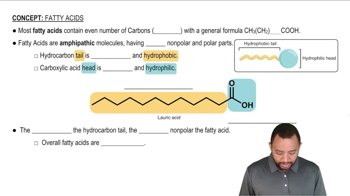
Fatty acids are carboxylic acids with long hydrocarbon chains, which can be saturated or unsaturated. Myristic acid is a saturated fatty acid with 14 carbon atoms, while linolenic acid is an unsaturated fatty acid with 18 carbon atoms and multiple double bonds. The type and arrangement of these fatty acids influence the physical properties of the triacylglycerol, such as melting point and fluidity.
Recommended video:
Guided course
2:00
Fatty Acids Concept 1

Esterification Reaction

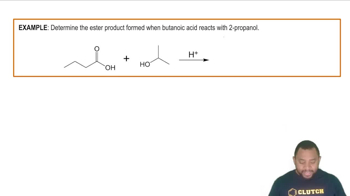
Esterification is a chemical reaction that forms an ester from an alcohol and a carboxylic acid, releasing water as a byproduct. In the context of triacylglycerol formation, the hydroxyl groups of glycerol react with the carboxyl groups of fatty acids, resulting in the formation of ester bonds. This reaction is crucial for synthesizing triacylglycerols and is facilitated by enzymes in biological systems.
Recommended video:
Guided course
0:46
Ester Reactions: Esterification Example 1