Pearson+ LogoPearson+ Logo
Ch.24 Lipid Metabolism
McMurry - Fundamentals of GOB 8th Edition
McMurry8th EditionFundamentals of GOBISBN: 9780134015187Not the one you use?Change textbook
Chapter 24, Problem 23

Write the equation for the hydrolysis of a triacylglycerol composed of stearic acid, oleic acid, and linoleic acid by pancreatic lipase.

Verified step by step guidance
1
Identify the structure of a triacylglycerol. A triacylglycerol consists of a glycerol backbone esterified to three fatty acid chains. In this case, the fatty acids are stearic acid (saturated), oleic acid (monounsaturated), and linoleic acid (polyunsaturated).
Understand the process of hydrolysis. Hydrolysis involves breaking the ester bonds in the triacylglycerol molecule by the addition of water, catalyzed by the enzyme pancreatic lipase.
Write the general reaction for the hydrolysis of a triacylglycerol: Triacylglycerol + 3H2O Glycerol + 3FattyAcids.
Substitute the specific fatty acids into the reaction. The products will be glycerol and the free fatty acids: stearic acid (C18H36O2), oleic acid (C18H34O2), and linoleic acid (C18H32O2).
Write the complete reaction: Triacylglycerol + 3H2O Glycerol + Stearic Acid + Oleic Acid + Linoleic Acid.

Verified video answer for a similar problem:

This video solution was recommended by our tutors as helpful for the problem above.
Video duration:
9m
Was this helpful?

Key Concepts

Here are the essential concepts you must grasp in order to answer the question correctly.

Triacylglycerol Structure

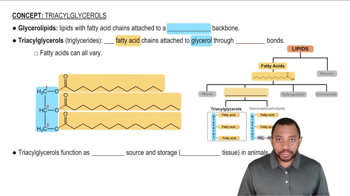
Triacylglycerols, also known as triglycerides, are esters formed from glycerol and three fatty acids. In this case, the fatty acids are stearic acid, oleic acid, and linoleic acid. Understanding the structure is crucial as it determines how the molecule interacts with enzymes like pancreatic lipase during hydrolysis.
Recommended video:
Guided course
1:52
Triacylglycerols Concept 1

Hydrolysis Reaction

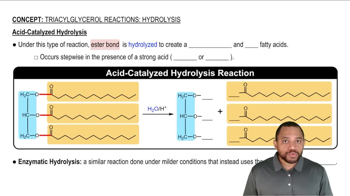
Hydrolysis is a chemical reaction that involves the breakdown of a compound by water. In the context of triacylglycerols, hydrolysis results in the release of glycerol and free fatty acids. This reaction is catalyzed by enzymes such as pancreatic lipase, which facilitates the cleavage of ester bonds.
Recommended video:
Guided course
3:09
Triacylglycerol Reactions: Hydrolysis Concept 1

Pancreatic Lipase Function

Pancreatic lipase is an enzyme produced by the pancreas that plays a key role in the digestion of dietary fats. It specifically hydrolyzes the ester bonds in triacylglycerols, converting them into glycerol and free fatty acids. Understanding its function is essential for writing the correct hydrolysis equation for the specified triacylglycerol.
Recommended video:
Guided course
02:16
Logarithmic Functions