Pearson+ LogoPearson+ Logo
Ch.24 Lipid Metabolism
McMurry - Fundamentals of GOB 8th Edition
McMurry8th EditionFundamentals of GOBISBN: 9780134015187Not the one you use?Change textbook
Chapter 24, Problem 21

What is the purpose of bile acids in lipid digestion?

Verified step by step guidance
1
Bile acids are amphipathic molecules, meaning they have both hydrophilic (water-attracting) and hydrophobic (water-repelling) regions. This property allows them to interact with both water and lipids.
During lipid digestion, bile acids are secreted by the liver and stored in the gallbladder. When fats enter the small intestine, bile acids are released into the digestive tract.
The primary role of bile acids is to emulsify lipids. Emulsification is the process of breaking down large fat globules into smaller droplets, increasing the surface area available for digestive enzymes to act upon.
By emulsifying lipids, bile acids enable the enzyme pancreatic lipase to efficiently hydrolyze triglycerides into free fatty acids and monoglycerides, which are more easily absorbed by the intestinal lining.
Once digestion is complete, bile acids are reabsorbed in the ileum (part of the small intestine) and recycled back to the liver in a process called enterohepatic circulation, ensuring their reuse in future digestion processes.

Verified video answer for a similar problem:

This video solution was recommended by our tutors as helpful for the problem above.
Video duration:
2m
Was this helpful?

Key Concepts

Here are the essential concepts you must grasp in order to answer the question correctly.

Bile Acids

Bile acids are steroid acids derived from cholesterol, produced in the liver and stored in the gallbladder. They play a crucial role in the emulsification of dietary fats, breaking them down into smaller droplets, which increases the surface area for digestive enzymes to act upon. This process is essential for the efficient absorption of lipids in the intestines.
Recommended video:

Emulsification

Emulsification is the process by which large fat globules are broken down into smaller droplets, allowing for better interaction with digestive enzymes. Bile acids facilitate this process by reducing the surface tension of fat droplets, making it easier for lipases to access and digest the fats. This is a critical step in lipid digestion and absorption.
Recommended video:
Guided course
2:54
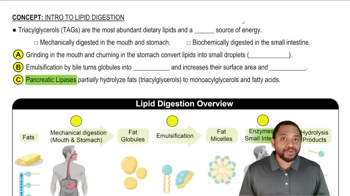
Intro to Lipid Digestion Concept 1

Lipid Absorption

Lipid absorption refers to the process by which digested fats are taken up by the intestinal cells and transported into the bloodstream. After emulsification and enzymatic digestion, the resulting fatty acids and monoglycerides are absorbed through the intestinal lining. This process is vital for providing energy and essential fatty acids to the body.
Recommended video:
Guided course
1:41
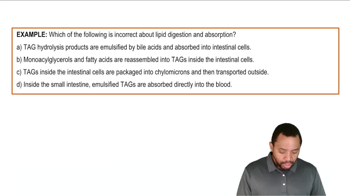
Digestion of Lipids Example 1