Pearson+ LogoPearson+ Logo
Ch.26 Nucleic Acids and Protein Synthesis
McMurry - Fundamentals of GOB 8th Edition
McMurry8th EditionFundamentals of GOBISBN: 9780134015187Not the one you use?Change textbook
Chapter 26, Problem 40

Draw the complete structure of uridine 5′- phosphate, one of the four major ribonucleotides.

Verified step by step guidance
1
Understand the structure of uridine 5′-phosphate: It is a ribonucleotide composed of three main components: (1) a nitrogenous base (uracil), (2) a ribose sugar, and (3) a phosphate group attached to the 5′ carbon of the ribose.
Start by drawing the uracil base: Uracil is a pyrimidine base with the molecular formula C₄H₄N₂O₂. It has a six-membered ring with two nitrogen atoms and two keto groups at positions 2 and 4.
Attach the ribose sugar to the uracil base: Ribose is a five-carbon sugar. Connect the 1′ carbon of the ribose to the nitrogen at position 1 of the uracil base via a β-N-glycosidic bond.
Add the phosphate group to the ribose sugar: The phosphate group is attached to the 5′ carbon of the ribose sugar. Draw a phosphate group (PO₄³⁻) connected to the 5′ carbon via a phosphoester bond.
Verify the structure: Ensure that all bonds are correctly drawn, the ribose sugar is in its furanose form, and the phosphate group is properly attached to the 5′ carbon. The final structure should represent uridine 5′-phosphate accurately.

Verified video answer for a similar problem:

This video solution was recommended by our tutors as helpful for the problem above.
Video duration:
4m
Was this helpful?

Key Concepts

Here are the essential concepts you must grasp in order to answer the question correctly.

Ribonucleotide Structure

Ribonucleotides are the building blocks of RNA, consisting of a ribose sugar, a phosphate group, and a nitrogenous base. In uridine 5'-phosphate, the ribose sugar is attached to the uracil base and a phosphate group at the 5' position. Understanding this structure is essential for recognizing how ribonucleotides function in nucleic acid synthesis.
Recommended video:
Guided course
1:01
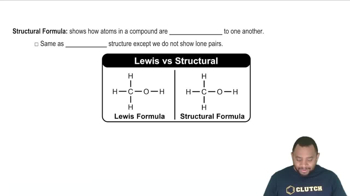
Structural Formula Concept 2

Phosphate Group

The phosphate group in ribonucleotides plays a crucial role in linking nucleotides together to form RNA strands. It is typically attached to the 5' carbon of the ribose sugar, contributing to the overall negative charge of the nucleic acid backbone. This charge is important for the stability and interactions of RNA molecules.
Recommended video:
Guided course
2:26
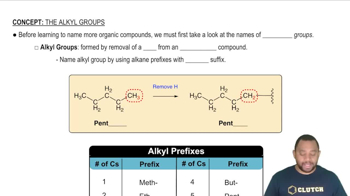
Alkyl Groups Concept 1

Nitrogenous Bases

Nitrogenous bases are organic molecules that contain nitrogen and are fundamental components of nucleotides. In uridine 5'-phosphate, the base is uracil, which pairs with adenine during RNA synthesis. Understanding the role of these bases is vital for grasping how genetic information is encoded and expressed in living organisms.
Recommended video:
Guided course
1:23
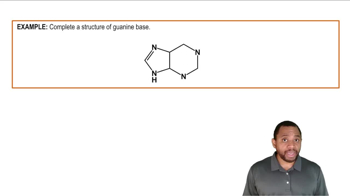
Nitrogenous Bases Example 3