Pearson+ LogoPearson+ Logo
Ch.12 Alcohols, Thiols, Ethers, Aldehydes, and Ketones
Timberlake - Chemistry: An Introduction to General, Organic, and Biological Chemistry 14th Edition
Timberlake14thChemistry: An Introduction to General, Organic, and Biological ChemistryISBN: 9781292472249Not the one you use?Change textbook
Chapter 12, Problem 43a

Write the IUPAC name for each of the following alcohols and phenols: (12.1)
a. <IMAGE>

Verified step by step guidance
1
Step 1: Identify the longest carbon chain that contains the hydroxyl (-OH) group. This chain will serve as the parent chain for naming the alcohol or phenol.
Step 2: Number the carbon atoms in the parent chain starting from the end closest to the hydroxyl group. This ensures the hydroxyl group gets the lowest possible number.
Step 3: Determine the substituents attached to the parent chain and their positions. Use the numbering from Step 2 to assign the correct locants to each substituent.
Step 4: Combine the substituent names, locants, and the parent chain name. Add the suffix '-ol' to indicate the presence of the hydroxyl group. If the compound is a phenol, use 'phenol' as the base name instead of a carbon chain.
Step 5: Ensure the name follows IUPAC rules for alphabetical order of substituents and proper placement of locants. Double-check for any stereochemistry or special naming considerations if applicable.

Verified video answer for a similar problem:

This video solution was recommended by our tutors as helpful for the problem above.
Was this helpful?

Key Concepts

Here are the essential concepts you must grasp in order to answer the question correctly.

IUPAC Nomenclature

IUPAC nomenclature is a systematic method for naming chemical compounds, ensuring that each name conveys specific information about the structure of the molecule. For alcohols, the name typically includes the longest carbon chain, the position of the hydroxyl (-OH) group, and the suffix '-ol'. Understanding this system is essential for accurately naming alcohols and phenols.
Recommended video:
Guided course
3:18
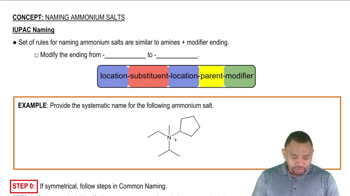
IUPAC Naming Concept 3

Functional Groups

Functional groups are specific groups of atoms within molecules that are responsible for the characteristic chemical reactions of those molecules. In the case of alcohols, the hydroxyl group (-OH) is the functional group that defines their properties. Recognizing functional groups is crucial for determining the correct IUPAC name and understanding the compound's reactivity.
Recommended video:
Guided course
1:11
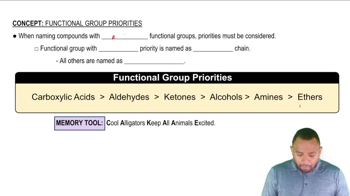
Functional Group Priorities Concept 1

Structural Isomerism

Structural isomerism occurs when compounds have the same molecular formula but different structural arrangements of atoms. This can lead to different IUPAC names for alcohols and phenols, depending on the position of the hydroxyl group or the arrangement of carbon chains. Being aware of isomerism is important for accurately naming and distinguishing between similar compounds.
Recommended video:
Guided course
1:01
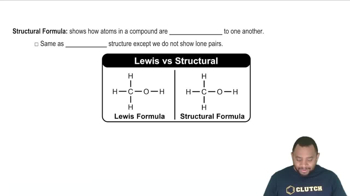
Structural Formula Concept 2