 Indietro
 Mullins 1st EditionCh. 5 - Chemical Reaction Analysis: Thermodynamics and Kinetics
Problema 17
The combustion of alkanes is exothermic (∆H° < 0) . Would you expect the combustion of butane or cyclobutane to be more exothermic?
Problema 18a
For each of the following processes, indicate whether you expect ∆S° to be greater than, less than, or equal to 0. Explain your answer.
(a) Boiling water
Problema 18b
For each of the following processes, indicate whether you expect ∆S° to be greater than, less than, or equal to 0. Explain your answer.
(b) 2 C6H14(l) + 19 O2(g) → 12 CO2(g) + 14 H2O(g)
Problema 18c
For each of the following processes, indicate whether you expect ∆S° to be greater than, less than, or equal to 0. Explain your answer.
(c)
Problema 18d
For each of the following processes, indicate whether you expect ∆S° to be greater than, less than, or equal to 0. Explain your answer.
(d)
Problema 19
If the following reaction is favorable, what can we say about the sign of ∆H°? Explain your answer.
Problema 20a
Draw a reaction coordinate diagram for a one step reaction that has the following values of Ea and ∆H. (a) Ea = 9 kcal/mol ; ∆H° = + 4 kcal/mol
Problema 20b
Draw a reaction coordinate diagram for a one step reaction that has the following values of Ea and ∆H. (b) Ea = 2 kcal/mol ; ∆H° = -17 kcal/mol
Problema 20c
Draw a reaction coordinate diagram for a one step reaction that has the following values of Ea and ∆H. (c) Ea = 5 kcal/mol; ∆H° = 0 kcal/mol
Problema 24a
For the following acid–base reaction, (a) identify the acid and conjugate acid
Problema 24b
For the following acid–base reaction, (b) calculate the equilibrium constant.
Problema 24c
For the following acid–base reaction, (c) calculate the ratio of butan-2-ol to 2-butoxide.
Problema 24d
For the following acid–base reaction, (d) calculate ∆G° at 298 K.
Problema 24e
For the following acid–base reaction, (e) calculate ∆G° at 273 K.
Problema 24f
For the following acid–base reaction, (f) calculate ∆G° at 373 K.
Problema 25a
Calculate ∆G°, ∆H°, and ∆S° for the following acid–base reactions. Rationalize the value of ∆H° based on the structure of the conjugate bases. [Assume T = 298 K.]
(a)
Problema 25b
Calculate ∆G°, ∆H°, and ∆S° for the following acid–base reactions. Rationalize the value of ∆H° based on the structure of the conjugate bases. [Assume T = 298 K.]
(b)
Problema 25c
Calculate ∆G°, ∆H°, and ∆S° for the following acid–base reactions. Rationalize the value of ∆H° based on the structure of the conjugate bases. [Assume T = 298 K.]
(c)
Problema 26a
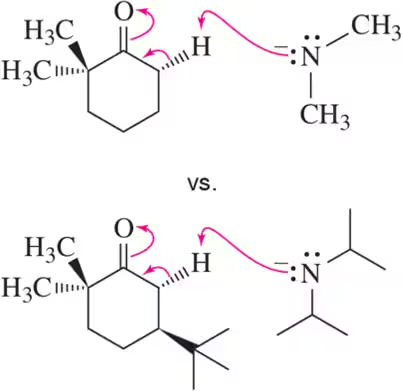
Within the following pairs, pick which reaction you would expect to be faster based on having a higher value of the frequency factor (A).
(a)
Problema 26b
Within the following pairs, pick which reaction you would expect to be faster based on having a higher value of the frequency factor (A).
(b)
Problema 27
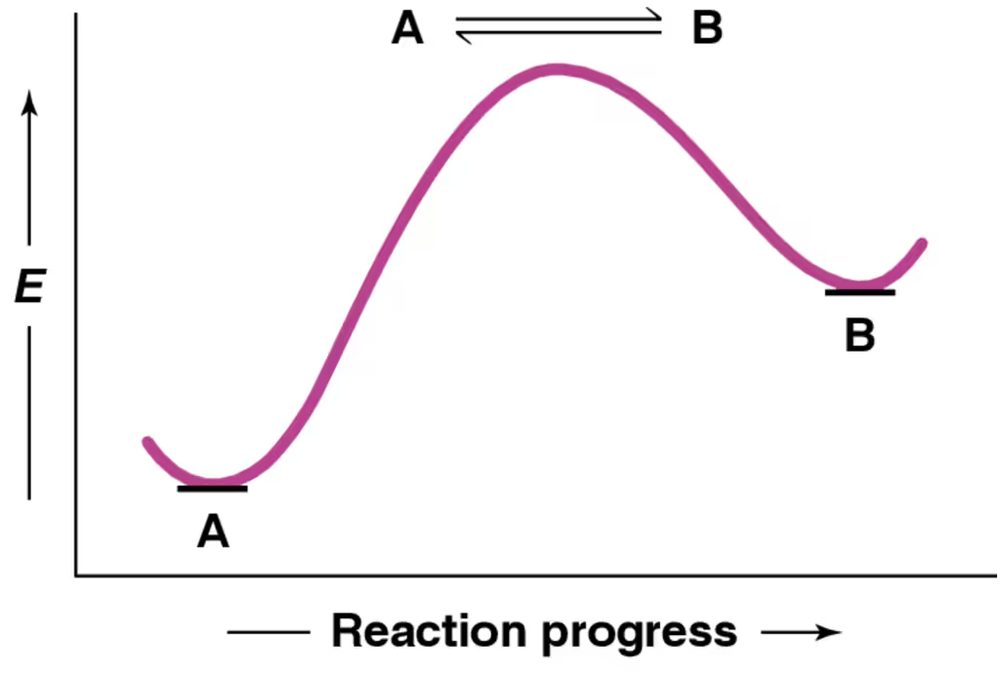
For the reaction coordinate diagram shown, is the forward or reverse reaction faster?
Problema 29a
For the following acid–base reactions studied in Assessment 5.25, draw a likely transition state. Be sure to indicate in your drawing the degree to which bonds are broken or formed.
(a)
Problema 29b
For the following acid–base reactions studied in Assessment 5.25, draw a likely transition state. Be sure to indicate in your drawing the degree to which bonds are broken or formed.
(b)
Problema 29c
For the following acid–base reactions studied in Assessment 5.25, draw a likely transition state. Be sure to indicate in your drawing the degree to which bonds are broken or formed.
(c) H3O+ + Br– ⇌ H2O + HBr
Problema 31a
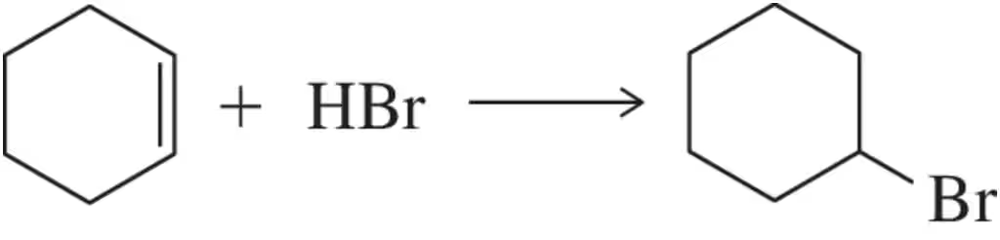
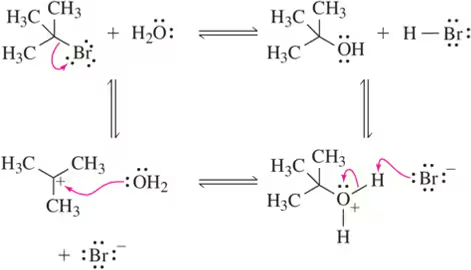
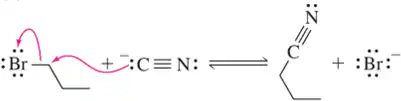
We discuss the following reactions in subsequent chapters. Given the mechanisms shown, draw the mechanism of the reverse reaction.
(a)
Problema 31b
We discuss the following reactions in subsequent chapters. Given the mechanisms shown, draw the mechanism of the reverse reaction.
(b)
Problema 32
Assuming that ∆H° = -15kcal/mol for the reaction in Assessment 5.31(b), show the transition state for the forward and reverse reactions.
Problema 34
Write the rate law for the following reaction and identify which molecules are present in the rate-determining step. Draw a possible transition state and propose a mechanism.
Problema 35
All things being equal, would you expect a first-order reaction to be faster or slower than a second-order reaction?
Problema 36
Third-order reactions are rare. Why do you think that is?











![Table displaying concentrations of [RBr] and [HO-] with corresponding reaction rates for control and trials.](https://static.studychannel.pearsonprd.tech/courses/organic-chemistry/thumbnails/1c9e5ad1-b4d8-44b4-9933-02c7b65962db)