
Ch. 10 - Alkynes: Electrophilic Addition and Redox Reactions
Mullins - Organic Chemistry: A Learner Centered Approach 1st Edition
Mullins1st EditionOrganic Chemistry: A Learner Centered ApproachISBN: 9780137566471당신이 사용하는 게 아니라요?교과서 변경
9장, 문제 50

In Section 10.8.1, you learned that alkenes react more quickly with electrophiles than do the corresponding alkynes (kalkene/kalkyne > 1). Explain why there is a greater disparity in the alkene versus alkyne reactivity in the addition of HBr as compared to the addition of Br2 [The rate data are not real, but are meant to illustrate a real trend.]

검증된 단계별 안내
1
Step 1: Analyze the provided image. The left side shows the relative rates of reaction for alkenes and alkynes with HBr, where the alkene reacts 100 times faster than the alkyne (kalkene/kalkyne = 100). The right side shows the relative rates of reaction for alkenes and alkynes with Br₂, where the alkene reacts 10 times faster than the alkyne (kalkene/kalkyne = 10).
Step 2: Recall the mechanism of addition reactions. In the case of HBr addition, the reaction proceeds via the formation of a carbocation intermediate. Alkenes form more stable carbocations due to hyperconjugation and inductive effects, whereas alkynes form less stable carbocations because the sp-hybridized carbon in alkynes is less able to stabilize positive charge.
Step 3: Compare the Br₂ addition mechanism. This reaction proceeds via a cyclic bromonium ion intermediate rather than a carbocation. The disparity in reactivity between alkenes and alkynes is smaller because the bromonium ion formation is less sensitive to the hybridization of the carbon atoms involved.
Step 4: Explain the greater disparity in HBr addition. The stability of the carbocation intermediate in HBr addition is the key factor that makes alkenes react much faster than alkynes. In contrast, the Br₂ addition mechanism does not involve carbocation formation, so the difference in reactivity is less pronounced.
Step 5: Conclude that the difference in reactivity trends is due to the nature of the intermediates formed during the reaction. HBr addition is highly dependent on carbocation stability, favoring alkenes, while Br₂ addition involves a bromonium ion intermediate, which reduces the disparity in reactivity between alkenes and alkynes.

비슷한 문제에 대한 검증된 영상 답변:

이 영상 해법은 위 문제에 도움이 된다고 튜터들이 추천한 것입니다.
도움이 되었나요?

주요 개념

질문에 올바르게 답하기 위해 반드시 이해해야 하는 핵심 개념들은 다음과 같습니다.

Electrophilic Addition Reactions

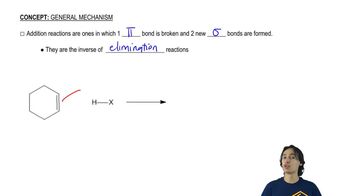
Electrophilic addition reactions involve the addition of electrophiles to nucleophilic sites in alkenes and alkynes. Alkenes, with their π bonds, are more reactive towards electrophiles due to the availability of electron density. This reactivity is influenced by the stability of the resulting carbocation intermediates formed during the reaction, which can differ significantly between alkenes and alkynes.
추천 영상:
05:39
Features of Addition Mechanisms.

Carbocation Stability

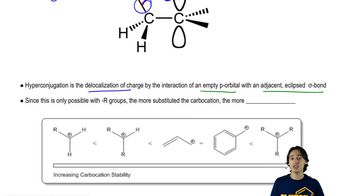
Carbocation stability is a crucial factor in determining the rate of electrophilic addition reactions. Alkenes typically form more stable carbocations than alkynes due to the presence of more substituents that can stabilize the positive charge. This increased stability leads to faster reaction rates for alkenes when reacting with electrophiles like HBr, compared to alkynes, which form less stable carbocations.
추천 영상:
05:58
Determining Carbocation Stability

Sterics and Electronic Effects

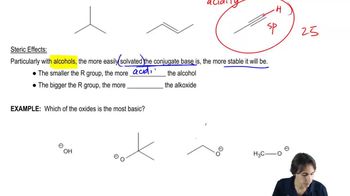
Steric and electronic effects play a significant role in the reactivity of alkenes and alkynes. The steric hindrance around the double or triple bond can affect how easily electrophiles approach and react with the substrate. Additionally, the electronic effects, such as the inductive effect from substituents, can influence the electron density at the reactive site, further affecting the reactivity of alkenes versus alkynes in reactions with different electrophiles like HBr and Br₂.
추천 영상:
02:53
Understanding steric effects.