Ch. 10 - Alkynes: Electrophilic Addition and Redox Reactions
Mullins - Organic Chemistry: A Learner Centered Approach 1st Edition
Mullins1st EditionOrganic Chemistry: A Learner Centered ApproachISBN: 9780137566471당신이 사용하는 게 아니라요?교과서 변경
9장, 문제 49e

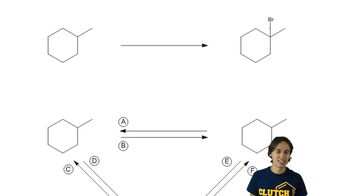
Synthesize the following molecules beginning with only organic molecules containing three carbons or fewer.
(e) Chemical structure showing a carbon chain with hydroxyl (OH) and chlorine (Cl) functional groups attached.

검증된 단계별 안내
1
Step 1: Analyze the target molecule and identify its functional groups, carbon skeleton, and any stereochemistry. Determine the number of carbons in the molecule and compare it to the starting materials (organic molecules with three carbons or fewer).
Step 2: Break down the synthesis into smaller steps by identifying key transformations required to build the target molecule. Consider reactions such as chain elongation, functional group interconversion, and stereochemical control.
Step 3: Select appropriate starting materials (e.g., propane, propene, propyne, or other three-carbon molecules) and determine how to modify them to introduce the necessary functional groups or extend the carbon chain. Use reactions like alkylation, oxidation, or addition reactions.
Step 4: Plan the sequence of reactions to achieve the desired connectivity and functional groups. For example, if chain elongation is required, use reactions like the Grignard reaction, aldol condensation, or Wittig reaction. If functional group interconversion is needed, consider reactions like reduction, oxidation, or substitution.
Step 5: Verify the feasibility of each step by considering reaction conditions, regioselectivity, and stereoselectivity. Ensure that the synthesis is efficient and avoids unnecessary steps or side reactions.

비슷한 문제에 대한 검증된 영상 답변:

이 영상 해법은 위 문제에 도움이 된다고 튜터들이 추천한 것입니다.
영상 길이:
8m

주요 개념

질문에 올바르게 답하기 위해 반드시 이해해야 하는 핵심 개념들은 다음과 같습니다.

Alkane Structure and Reactivity

Alkanes are saturated hydrocarbons consisting only of carbon and hydrogen atoms, with single bonds between carbon atoms. Understanding their structure is crucial for synthesis, as they serve as the simplest organic molecules. The reactivity of alkanes is limited compared to other functional groups, but they can undergo reactions such as combustion and halogenation, which are foundational in organic synthesis.
추천 영상:
02:47
Functionalizing Alkanes

Functional Groups

Functional groups are specific groups of atoms within molecules that determine the chemical reactivity and properties of those molecules. In organic chemistry, common functional groups include alcohols, aldehydes, and carboxylic acids. Recognizing and manipulating these groups is essential for synthesizing more complex molecules from simpler precursors, especially when starting with three-carbon or smaller organic molecules.
추천 영상:
02:36
Identifying Functional Groups

Synthetic Pathways

Synthetic pathways refer to the series of chemical reactions that transform starting materials into desired products. In organic synthesis, understanding how to navigate these pathways is vital for constructing complex molecules from simpler ones. This involves knowledge of reaction mechanisms, conditions, and the ability to predict the outcomes of reactions, which is particularly important when working with limited starting materials like those containing three carbons or fewer.
추천 영상:
가이드 코스
2:13
Energy Production In Biochemical Pathways Concept 1