Ch. 13 - Alcohols, Ethers and Related Compounds: Substitution and Elimination
Mullins - Organic Chemistry: A Learner Centered Approach 1st Edition
Mullins1st EditionOrganic Chemistry: A Learner Centered ApproachISBN: 9780137566471당신이 사용하는 게 아니라요?교과서 변경
12장, 문제 81b

A variety of organometallics, which as strong nucleophiles can react with epoxides, are introduced in Chapter 16. Predict the product of these reactions. [Hint: Assume the carbon–metal bond in each is ionic, with the carbon possessing the negative charge.]
(b) Chemical reaction diagram illustrating the Grignard reaction with MgBr in THF and H3O+ quench, highlighting ionic carbon-metal bond.

검증된 단계별 안내
1
Identify the organometallic reagent in the reaction. Organometallic compounds typically have a carbon-metal bond, where the carbon is nucleophilic due to its partial negative charge.
Recognize the epoxide as the electrophile in the reaction. Epoxides are three-membered cyclic ethers with significant ring strain, making them highly reactive toward nucleophiles.
Determine the site of nucleophilic attack. The nucleophile (carbon from the organometallic reagent) will attack the less sterically hindered carbon of the epoxide, leading to ring opening. This is due to the SN2-like mechanism of the reaction.
Add a protonation step. After the nucleophilic attack and ring opening, the negatively charged oxygen (from the epoxide) will be protonated by a suitable proton source (e.g., water or an acid) to form the final alcohol product.
Draw the final product. The product will be an alcohol where the nucleophile has added to the less hindered carbon of the epoxide, and the oxygen from the epoxide is now part of a hydroxyl group.

비슷한 문제에 대한 검증된 영상 답변:

이 영상 해법은 위 문제에 도움이 된다고 튜터들이 추천한 것입니다.
도움이 되었나요?

주요 개념

질문에 올바르게 답하기 위해 반드시 이해해야 하는 핵심 개념들은 다음과 같습니다.

Organometallic Compounds

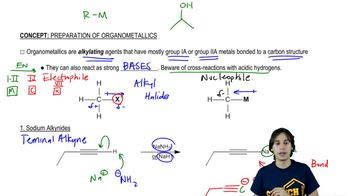
Organometallic compounds are molecules that contain a bond between a carbon atom of an organic group and a metal. These compounds are known for their strong nucleophilic properties, allowing them to react with electrophiles, such as epoxides. The metal can vary, influencing the reactivity and stability of the compound.
추천 영상:
02:50
Ruining Organometallics

Epoxide Reactivity

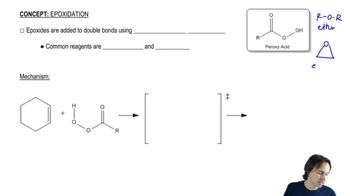
Epoxides are three-membered cyclic ethers that are highly reactive due to the strain in their ring structure. They can undergo nucleophilic attack at the less hindered carbon atom, leading to ring-opening reactions. Understanding the mechanism of this reaction is crucial for predicting the products formed when epoxides react with nucleophiles.
추천 영상:
02:19
General properties of epoxidation.

Ionic Carbon-Metal Bond

In the context of organometallics, assuming an ionic carbon-metal bond means that the carbon atom carries a negative charge, making it a strong nucleophile. This assumption simplifies the analysis of the reaction mechanism, as it allows for straightforward predictions about how the nucleophile will interact with the electrophilic epoxide, leading to the formation of specific products.
추천 영상:
가이드 코스
3:39
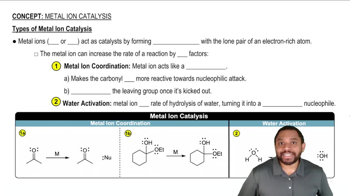
Metal Ion Catalysis Concept 1