Ch. 13 - Alcohols, Ethers and Related Compounds: Substitution and Elimination
Mullins - Organic Chemistry: A Learner Centered Approach 1st Edition
Mullins1st EditionOrganic Chemistry: A Learner Centered ApproachISBN: 9780137566471당신이 사용하는 게 아니라요?교과서 변경
12장, 문제 84a

Show how a protecting group might be used to make these reactions successful.
(a)

검증된 단계별 안내
1
Identify the functional groups in the starting material: The molecule contains a hydroxyl group (OH) and a chloro group (Cl) attached to a benzene ring. The target molecule has an alkyne group instead of the chloro group.
Recognize the need for a protecting group: The hydroxyl group is susceptible to reactions that might interfere with the transformation of the chloro group to an alkyne. Protecting the hydroxyl group will prevent unwanted side reactions.
Select an appropriate protecting group: A common protecting group for alcohols is the silyl ether, such as tert-butyldimethylsilyl (TBS) ether. This group can be introduced using a silyl chloride reagent in the presence of a base.
Perform the protection step: React the starting material with TBS-Cl and a base like imidazole to convert the hydroxyl group into a TBS ether, thus protecting it from further reactions.
Carry out the desired transformation: With the hydroxyl group protected, proceed with the conversion of the chloro group to an alkyne. This can be achieved through a series of reactions, such as elimination to form an alkene followed by a Sonogashira coupling to introduce the alkyne group.

비슷한 문제에 대한 검증된 영상 답변:

이 영상 해법은 위 문제에 도움이 된다고 튜터들이 추천한 것입니다.
도움이 되었나요?

주요 개념

질문에 올바르게 답하기 위해 반드시 이해해야 하는 핵심 개념들은 다음과 같습니다.

Protecting Groups

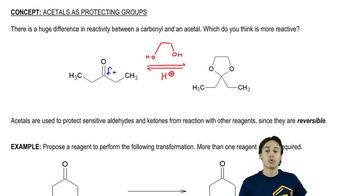
Protecting groups are chemical moieties that temporarily mask reactive functional groups in a molecule, allowing for selective reactions to occur without interference. They are crucial in multi-step organic synthesis, as they enable chemists to control the reactivity of specific sites, ensuring that desired transformations can be achieved without unwanted side reactions.
추천 영상:
02:44
Protecting Groups

Functional Group Reactivity

Different functional groups exhibit varying reactivities under specific conditions. Understanding the reactivity of functional groups is essential for designing synthetic pathways, as it helps predict how a molecule will behave in a reaction. By using protecting groups, chemists can manipulate these reactivities to achieve desired outcomes in complex organic transformations.
추천 영상:
02:36
Identifying Functional Groups

Deprotection

Deprotection is the process of removing a protecting group after the desired reaction has taken place. This step is critical in restoring the original functional group for further reactions or for the final product. The choice of protecting group often depends on the conditions required for deprotection, which must be compatible with the other functional groups present in the molecule.
추천 영상:
05:49
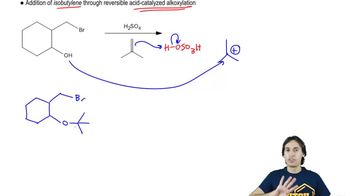
Mechanism of t-Butyl Ether Protecting Groups.