Ch. 13 - Alcohols, Ethers and Related Compounds: Substitution and Elimination
Mullins - Organic Chemistry: A Learner Centered Approach 1st Edition
Mullins1st EditionOrganic Chemistry: A Learner Centered ApproachISBN: 9780137566471당신이 사용하는 게 아니라요?교과서 변경
12장, 문제 50

Every oxidation is accompanied by a reduction. Identify the species that is reduced in the Swern oxidation in Assessment 13.48.
Swern oxidation reaction mechanism showing dimethyl sulfoxide, oxalyl chloride, and triethylamine with intermediate structures.

검증된 단계별 안내
1
Understand the Swern oxidation: It is a chemical reaction used to convert primary and secondary alcohols to aldehydes and ketones, respectively, using dimethyl sulfoxide (DMSO) and oxalyl chloride (COCl₂) in the presence of a base like triethylamine.
Identify the role of DMSO: In the Swern oxidation, DMSO acts as the oxidizing agent. It is converted to a sulfonium ion intermediate during the reaction.
Recognize the reduction process: During the Swern oxidation, DMSO is reduced to dimethyl sulfide (DMS), which is the species that is reduced in this reaction.
Consider the overall reaction: The alcohol is oxidized to an aldehyde or ketone, while DMSO is reduced to DMS. This demonstrates the principle that every oxidation is accompanied by a reduction.
Review the mechanism: The mechanism involves the formation of an activated DMSO complex, which facilitates the transfer of oxygen from DMSO to the alcohol, resulting in the reduction of DMSO to DMS.

비슷한 문제에 대한 검증된 영상 답변:

이 영상 해법은 위 문제에 도움이 된다고 튜터들이 추천한 것입니다.
도움이 되었나요?

주요 개념

질문에 올바르게 답하기 위해 반드시 이해해야 하는 핵심 개념들은 다음과 같습니다.

Swern Oxidation

Swern oxidation is a chemical reaction used to convert primary and secondary alcohols into aldehydes and ketones, respectively. It involves the use of dimethyl sulfoxide (DMSO) activated by oxalyl chloride, followed by the addition of a base like triethylamine. Understanding the reagents and the mechanism is crucial for identifying the species involved in the oxidation and reduction processes.
추천 영상:
03:20
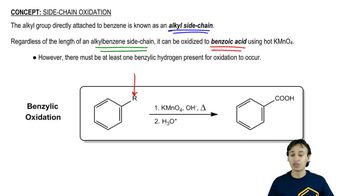
Benzylic Oxidation

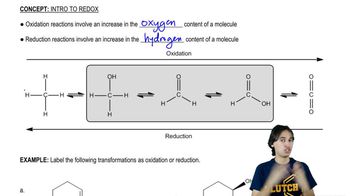
Oxidation-Reduction (Redox) Reactions

Redox reactions involve the transfer of electrons between two species, where one species is oxidized (loses electrons) and the other is reduced (gains electrons). In the context of Swern oxidation, identifying the species that undergoes reduction is essential, as it complements the oxidation of the alcohol substrate. Recognizing electron transfer and changes in oxidation states is key to understanding these reactions.
추천 영상:
06:02
General Features of Redox

Role of Dimethyl Sulfoxide (DMSO)

In Swern oxidation, DMSO acts as the oxidizing agent, facilitating the conversion of alcohols to carbonyl compounds. During the reaction, DMSO is reduced to dimethyl sulfide, which is the species that gains electrons. Understanding the transformation of DMSO and its role in the mechanism helps in identifying the reduced species in the reaction.
추천 영상:
03:51
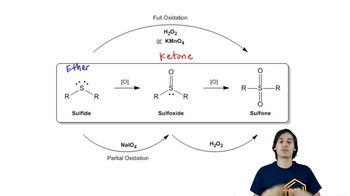
Reagents used to oxidize Sulfides.