Ch. 13 - Alcohols, Ethers and Related Compounds: Substitution and Elimination
Mullins - Organic Chemistry: A Learner Centered Approach 1st Edition
Mullins1st EditionOrganic Chemistry: A Learner Centered ApproachISBN: 9780137566471당신이 사용하는 게 아니라요?교과서 변경
12장, 문제 49

In Assessment 13.48, identify the individual step that represents the general mechanism for all alcohol oxidation reactions.

검증된 단계별 안내
1
Identify the alcohol oxidation reaction in the provided mechanism. Alcohol oxidation typically involves the conversion of an alcohol to a carbonyl compound, such as an aldehyde or ketone.
Observe the step where the alcohol (OH group) is transformed into a carbonyl group (C=O). This is the key transformation in alcohol oxidation reactions.
In the provided mechanism, locate the step where the alcohol is initially activated by a reagent, often involving the formation of a good leaving group.
Look for the step where the activated alcohol undergoes elimination to form the carbonyl compound, which is the hallmark of oxidation.
Recognize that the general mechanism for alcohol oxidation involves the removal of hydrogen from the alcohol and the formation of a double bond with oxygen, resulting in a carbonyl group.

비슷한 문제에 대한 검증된 영상 답변:

이 영상 해법은 위 문제에 도움이 된다고 튜터들이 추천한 것입니다.
도움이 되었나요?

주요 개념

질문에 올바르게 답하기 위해 반드시 이해해야 하는 핵심 개념들은 다음과 같습니다.

Alcohol Oxidation Mechanism

The oxidation of alcohols generally involves the conversion of the hydroxyl (-OH) group into a carbonyl (C=O) group. This process can occur through various mechanisms, including the formation of a carbocation intermediate or via the direct transfer of electrons. Understanding the specific steps in this mechanism is crucial for identifying how different oxidizing agents affect the reaction.
추천 영상:
05:53
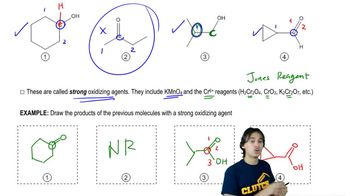
Strong oxidizing agents

Oxidizing Agents

Oxidizing agents are substances that facilitate the oxidation of alcohols by accepting electrons. Common oxidizing agents include potassium dichromate (K2Cr2O7), sodium dichromate (Na2Cr2O7), and pyridinium chlorochromate (PCC). Each oxidizing agent has a distinct mechanism and can lead to different products, such as aldehydes, ketones, or carboxylic acids, depending on the conditions used.
추천 영상:
03:40
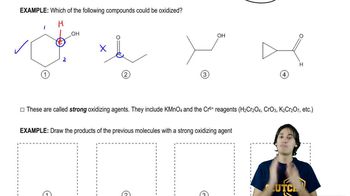
Strong oxidizing agents

Reaction Conditions

The conditions under which alcohol oxidation occurs, such as temperature, solvent, and pH, significantly influence the reaction pathway and the final products. For instance, mild conditions may lead to the formation of aldehydes, while harsher conditions can result in complete oxidation to carboxylic acids. Understanding these conditions is essential for predicting the outcome of the oxidation reaction.
추천 영상:
가이드 코스
1:18
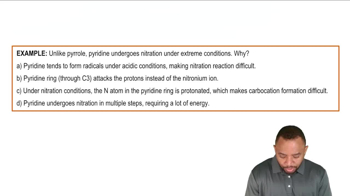
EAS Reactions of Pyridine Example 1