Ch. 13 - Alcohols, Ethers and Related Compounds: Substitution and Elimination
Mullins - Organic Chemistry: A Learner Centered Approach 1st Edition
Mullins1st EditionOrganic Chemistry: A Learner Centered ApproachISBN: 9780137566471당신이 사용하는 게 아니라요?교과서 변경
12장, 문제 57a

Fill in the missing reactant, reagent, or product for each of the following oxidation reactions.
(a)

검증된 단계별 안내
1
Identify the type of alcohol present in the reactant. The structure shows a secondary alcohol, as the hydroxyl group (-OH) is attached to a carbon atom that is connected to two other carbon atoms.
Recognize the type of oxidation reaction. Secondary alcohols are typically oxidized to ketones.
Determine the appropriate oxidizing agent for converting a secondary alcohol to a ketone. Common reagents include PCC (Pyridinium Chlorochromate) or Jones reagent (Chromic acid, H2CrO4).
Consider the reaction conditions. PCC is often used in anhydrous conditions, while Jones reagent requires aqueous acidic conditions.
Select the reagent based on the desired reaction conditions and the specific requirements of the reaction. For this transformation, PCC is a suitable choice for oxidizing the secondary alcohol to a ketone without over-oxidation.

비슷한 문제에 대한 검증된 영상 답변:

이 영상 해법은 위 문제에 도움이 된다고 튜터들이 추천한 것입니다.

주요 개념

질문에 올바르게 답하기 위해 반드시 이해해야 하는 핵심 개념들은 다음과 같습니다.

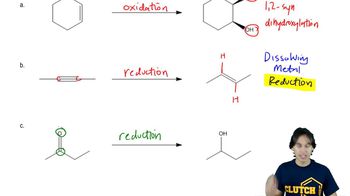
Oxidation-Reduction Reactions

Oxidation-reduction (redox) reactions involve the transfer of electrons between substances, leading to changes in oxidation states. In these reactions, oxidation refers to the loss of electrons, while reduction refers to the gain of electrons. Understanding these processes is crucial for identifying reactants and products in organic reactions, particularly in the context of oxidation reactions.
추천 영상:
00:54
Distinguishing between Oxidation and Reduction

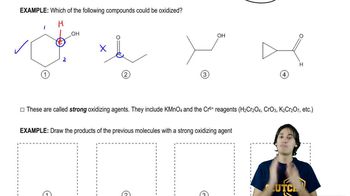
Common Oxidizing Agents

Oxidizing agents are substances that facilitate the oxidation of other compounds by accepting electrons. Common oxidizing agents in organic chemistry include potassium permanganate (KMnO4), chromium trioxide (CrO3), and hydrogen peroxide (H2O2). Recognizing these agents helps predict the products of oxidation reactions and the conditions under which they occur.
추천 영상:
03:40
Strong oxidizing agents

Functional Group Transformations

Functional group transformations are chemical reactions that convert one functional group into another, often altering the properties and reactivity of the molecule. In oxidation reactions, alcohols can be converted to aldehydes or ketones, and further to carboxylic acids. Understanding these transformations is essential for predicting the outcome of oxidation reactions and filling in missing components.
추천 영상:
02:36
Identifying Functional Groups