Ch. 13 - Alcohols, Ethers and Related Compounds: Substitution and Elimination
Mullins - Organic Chemistry: A Learner Centered Approach 1st Edition
Mullins1st EditionOrganic Chemistry: A Learner Centered ApproachISBN: 9780137566471당신이 사용하는 게 아니라요?교과서 변경
12장, 문제 54

Tertiary (3°)alcohols are not oxidized by chromic acid. Why?
Tertiary alcohol structure with chromic acid, H2CrO4, arrow pointing to "not oxidized" text.

검증된 단계별 안내
1
Understand the structure of tertiary alcohols: Tertiary alcohols have the hydroxyl group (-OH) attached to a carbon atom that is connected to three other carbon atoms. This means there are no hydrogen atoms directly attached to the carbon bearing the hydroxyl group.
Review the oxidation process: Oxidation of alcohols typically involves the removal of hydrogen atoms from the carbon atom bonded to the hydroxyl group, forming a carbonyl group. For primary and secondary alcohols, this process is possible because they have hydrogen atoms attached to the carbon with the hydroxyl group.
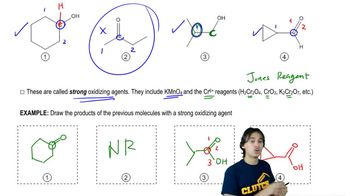
Consider the role of chromic acid: Chromic acid (H₂CrO₄) is a strong oxidizing agent that can convert primary alcohols to carboxylic acids and secondary alcohols to ketones by removing hydrogen atoms from the carbon atom bonded to the hydroxyl group.
Analyze the limitation with tertiary alcohols: Since tertiary alcohols lack hydrogen atoms on the carbon with the hydroxyl group, chromic acid cannot facilitate the removal of hydrogen atoms to form a carbonyl group. Therefore, tertiary alcohols cannot be oxidized by chromic acid.
Conclude the reasoning: The absence of hydrogen atoms on the carbon atom bonded to the hydroxyl group in tertiary alcohols prevents the oxidation process, making them resistant to oxidation by chromic acid.

비슷한 문제에 대한 검증된 영상 답변:

이 영상 해법은 위 문제에 도움이 된다고 튜터들이 추천한 것입니다.
영상 길이:
6m
도움이 되었나요?

주요 개념

질문에 올바르게 답하기 위해 반드시 이해해야 하는 핵심 개념들은 다음과 같습니다.

Oxidation of Alcohols

Oxidation in organic chemistry refers to the process where a molecule loses electrons, often involving the addition of oxygen or removal of hydrogen. Primary and secondary alcohols can be oxidized to aldehydes and ketones, respectively, using oxidizing agents like chromic acid. However, tertiary alcohols lack a hydrogen atom on the carbon bearing the hydroxyl group, making them resistant to oxidation.
추천 영상:
05:53
Strong oxidizing agents

Structure of Tertiary Alcohols

Tertiary alcohols have the hydroxyl group (-OH) attached to a carbon atom that is connected to three other carbon atoms. This structure means there is no hydrogen atom on the carbon with the hydroxyl group, which is necessary for oxidation to occur. Without this hydrogen, the typical oxidation pathway cannot proceed, preventing the formation of carbonyl compounds.
추천 영상:
가이드 코스
2:07
Tertiary Protein Structure Concept 1

Chromic Acid as an Oxidizing Agent

Chromic acid (H2CrO4) is a strong oxidizing agent commonly used to oxidize primary and secondary alcohols to aldehydes and ketones. It works by accepting electrons from the alcohol, facilitating the removal of hydrogen atoms. However, in tertiary alcohols, the absence of a hydrogen atom on the hydroxyl-bearing carbon means chromic acid cannot initiate the oxidation process, leaving the alcohol unchanged.
추천 영상:
05:53
Strong oxidizing agents