Ch. 13 - Alcohols, Ethers and Related Compounds: Substitution and Elimination
Mullins - Organic Chemistry: A Learner Centered Approach 1st Edition
Mullins1st EditionOrganic Chemistry: A Learner Centered ApproachISBN: 9780137566471당신이 사용하는 게 아니라요?교과서 변경
12장, 문제 88d

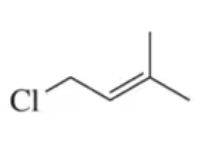
Predict the product(s) that would result when the following molecules are allowed to react under the following conditions: (i) 1. BH3 2. NaOH, H2O2 (ii) 1. Hg(OAc)2 2. NaBH4 (iii) H2SO4 , H2O (iv) 1. OsO4 2. NaHSO3 (v) H2O (vi) NaOH, H2O . If there is no reaction, write 'no reaction.'
(d)

검증된 단계별 안내
1
Step 1: Analyze the given reaction conditions for each case. Each set of reagents corresponds to a specific organic reaction mechanism. For example, (i) involves hydroboration-oxidation, (ii) involves oxymercuration-demercuration, (iii) involves acid-catalyzed hydration, (iv) involves syn-dihydroxylation, (v) involves simple hydration, and (vi) involves basic hydrolysis.
Step 2: For (i) 1. BH₃ 2. NaOH, H₂O₂: This is a hydroboration-oxidation reaction. It adds water (H and OH) across a double bond in an anti-Markovnikov fashion, with syn addition. Identify the double bond in the molecule and predict the product by adding H to the more substituted carbon and OH to the less substituted carbon.
Step 3: For (ii) 1. Hg(OAc)₂ 2. NaBH₄: This is an oxymercuration-demercuration reaction. It adds water (H and OH) across a double bond in a Markovnikov fashion, without carbocation rearrangement. Locate the double bond in the molecule and predict the product by adding OH to the more substituted carbon and H to the less substituted carbon.
Step 4: For (iii) H₂SO₄, H₂O: This is an acid-catalyzed hydration reaction. It adds water (H and OH) across a double bond in a Markovnikov fashion, but carbocation rearrangement is possible. Identify the double bond, consider possible rearrangements, and predict the product by adding OH to the more substituted carbon and H to the less substituted carbon.
Step 5: For (iv) 1. OsO₄ 2. NaHSO₃: This is a syn-dihydroxylation reaction. It adds two hydroxyl groups (OH and OH) across a double bond in a syn fashion. Locate the double bond in the molecule and predict the product by adding OH groups to both carbons of the double bond on the same side of the molecule.

비슷한 문제에 대한 검증된 영상 답변:

이 영상 해법은 위 문제에 도움이 된다고 튜터들이 추천한 것입니다.
영상 길이:
2m
도움이 되었나요?

주요 개념

질문에 올바르게 답하기 위해 반드시 이해해야 하는 핵심 개념들은 다음과 같습니다.

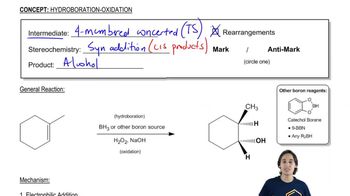
Hydroboration-Oxidation

Hydroboration-oxidation is a two-step reaction that converts alkenes into alcohols. In the first step, BH₃ adds to the double bond of the alkene, forming a trialkylborane intermediate. The second step involves oxidation with H₂O₂ and NaOH, which replaces the boron with a hydroxyl group, yielding an alcohol. This reaction is notable for its anti-Markovnikov selectivity.
추천 영상:
06:38
General properties of hydroboration-oxidation.

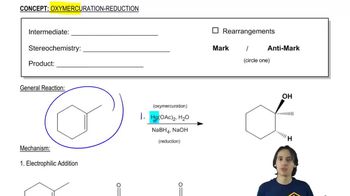
Oxymercuration-Demercuration

Oxymercuration-demercuration is a method for converting alkenes to alcohols via mercuric acetate. The alkene reacts with Hg(OAc)₂ to form a mercurial intermediate, which is then reduced by NaBH₄ to yield an alcohol. This reaction follows Markovnikov's rule, where the hydroxyl group attaches to the more substituted carbon of the alkene.
추천 영상:
05:
General properties of oxymercuration-reduction.

Sulfation and Hydration Reactions

Sulfation and hydration reactions involve the addition of sulfuric acid (H₂SO₄) and water (H₂O) to alkenes. The alkene reacts with H₂SO₄ to form an alkyl sulfate, which can then be hydrolyzed to produce an alcohol. This reaction also adheres to Markovnikov's rule, leading to the formation of more stable carbocation intermediates.
추천 영상:
09:11
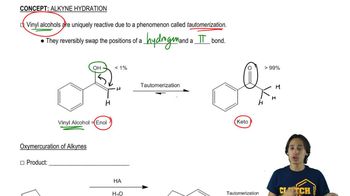
Alkyne Hydration