Ch. 13 - Alcohols, Ethers and Related Compounds: Substitution and Elimination
Mullins - Organic Chemistry: A Learner Centered Approach 1st Edition
Mullins1st EditionOrganic Chemistry: A Learner Centered ApproachISBN: 9780137566471당신이 사용하는 게 아니라요?교과서 변경
12장, 문제 106a(vii,viii)

Predict the product(s) that would result when molecules (a)–(p) are allowed to react under the following conditions: (vii) HCl; (viii) HBr. If no reaction occurs, write 'no reaction.'  
(a) Chemical structure of phenol, featuring a hydroxyl group (OH) attached to a benzene ring.

검증된 단계별 안내
1
Identify the functional group in the given molecule. The structure shows a benzyl alcohol, which has a hydroxyl group (-OH) attached to a benzyl group.
Consider the reaction with HCl. The hydroxyl group can be protonated by HCl, forming water, which is a good leaving group.
After the formation of water, a carbocation intermediate is generated. In this case, a benzyl carbocation, which is relatively stable due to resonance with the aromatic ring.
The chloride ion (Cl-) from HCl can then attack the carbocation, leading to the formation of benzyl chloride.
Repeat the same process for HBr. The hydroxyl group is protonated by HBr, forming water as a leaving group, and a benzyl carbocation is formed. The bromide ion (Br-) then attacks the carbocation, resulting in the formation of benzyl bromide.

비슷한 문제에 대한 검증된 영상 답변:

이 영상 해법은 위 문제에 도움이 된다고 튜터들이 추천한 것입니다.
영상 길이:
3m
도움이 되었나요?

주요 개념

질문에 올바르게 답하기 위해 반드시 이해해야 하는 핵심 개념들은 다음과 같습니다.

Acid-Base Reactions

Acid-base reactions involve the transfer of protons (H+) between reactants. In organic chemistry, strong acids like HCl and HBr can protonate nucleophiles or react with bases, influencing the reactivity of various functional groups. Understanding how acids interact with different substrates is crucial for predicting reaction outcomes.
추천 영상:
02:49
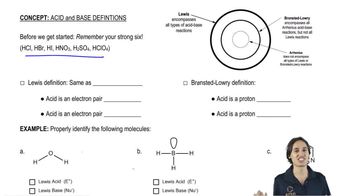
The Lewis definition of acids and bases.

Nucleophilicity and Electrophilicity

Nucleophilicity refers to the ability of a species to donate an electron pair, while electrophilicity is the ability to accept an electron pair. In the context of reactions with HCl and HBr, identifying which reactants act as nucleophiles and which as electrophiles helps predict the products formed. This concept is fundamental in determining reaction mechanisms.
추천 영상:
03:
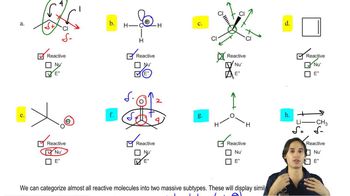
Nucleophile or Electrophile

Reaction Mechanisms

Reaction mechanisms describe the step-by-step process by which reactants transform into products. They provide insight into the intermediates formed and the energy changes involved. Understanding the mechanism is essential for predicting the products of reactions with acids like HCl and HBr, as it reveals how bonds are broken and formed during the reaction.
추천 영상:
02:16
Heck Reaction Mechanism
관련 실천
교과서 질문

Predict the product(s) that would result when molecules (a)–(p) are allowed to react under the following conditions: (xi) HOCl, H₂O (xii) HIO₄. If no reaction occurs, write 'no reaction.'  

(a)

739
views

교과서 질문

Predict the product(s) that would result when molecules (a)–(p) are allowed to react under the following conditions: (i) SOCl₂ ; (ii) PBr₃. If no reaction occurs, write 'no reaction.'  

(a)

870
views
교과서 질문

Predict the product(s) that would result when molecules (a)–(p) are allowed to react under the following conditions: (i) SOCl₂ ; (iii) SOCl₂, NEt₃. If no reaction occurs, write 'no reaction.'

(c)

585
views
교과서 질문

Predict the product(s) that would result when molecules (a)–(p) are allowed to react under the following conditions: (i) SOCl₂ ; (ii) PBr₃ ; (iii) SOCl₂ , NEt₃ (iv) 1. TsCl, Et₃N 2. NaCN; (v) 1. TsCl, Et₃N 2. NaOt-Bu (vi) H₂SO₄ (vii) HCl; (viii) HBr; (ix) PCC; (x) H₂CrO₄ , H₂O (xi) HOCl, H₂O (xii) HIO₄ If no reaction occurs, write 'no reaction.'

(c)

710
views
교과서 질문

Predict the product(s) that would result when molecules (a)–(p) are allowed to react under the following conditions: (i) SOCl₂ ; (ii) PBr₃ ; (iii) SOCl₂ , NEt₃ (iv) 1. TsCl, Et₃N 2. NaCN; (v) 1. TsCl, Et₃N 2. NaOt-Bu (vi) H₂SO₄ (vii) HCl; (viii) HBr; (ix) PCC; (x) H₂CrO₄ , H₂O (xi) HOCl, H₂O (xii) HIO₄ If no reaction occurs, write 'no reaction.'

(c)

743
views
교과서 질문

Predict the product(s) that would result when molecules (a)–(p) are allowed to react under the following conditions: (iii) SOCl2 , NEt3. If no reaction occurs, write 'no reaction.'  

(a)

445
views